Black holes are among the most fascinating and enigmatic objects in the universe. From stellar-mass black holes formed by collapsing stars to supermassive black holes lurking at galaxy centers, these gravitational powerhouses challenge our understanding of physics. In this comprehensive guide, we’ll explore what black holes are, how they form, recent discoveries in 2025, and why they continue to captivate scientists and the public alike.
What Is a Black Hole?
A black hole is a region of spacetime where gravity is so intense that nothing not even light can escape. This boundary is called the event horizon. Black holes aren’t “holes” in the traditional sense but incredibly dense concentrations of matter squeezed into a tiny space.
According to NASA, black holes form when massive stars exhaust their fuel and collapse under their own gravity. Smaller stars become white dwarfs or neutron stars, but those over about 3 solar masses can form black holes.
Key facts:
- No escape: Once past the event horizon, escape velocity exceeds the speed of light.
- Sizes vary: From a few times the Sun’s mass (stellar black holes) to billions (supermassive black holes).
- Invisible but detectable: We observe them through effects on nearby matter, like accretion disks or gravitational lensing.
Types of Black Holes
There are three main types:
- Stellar-Mass Black Holes: Formed from dying massive stars. Typically 3–100 times the Sun’s mass.
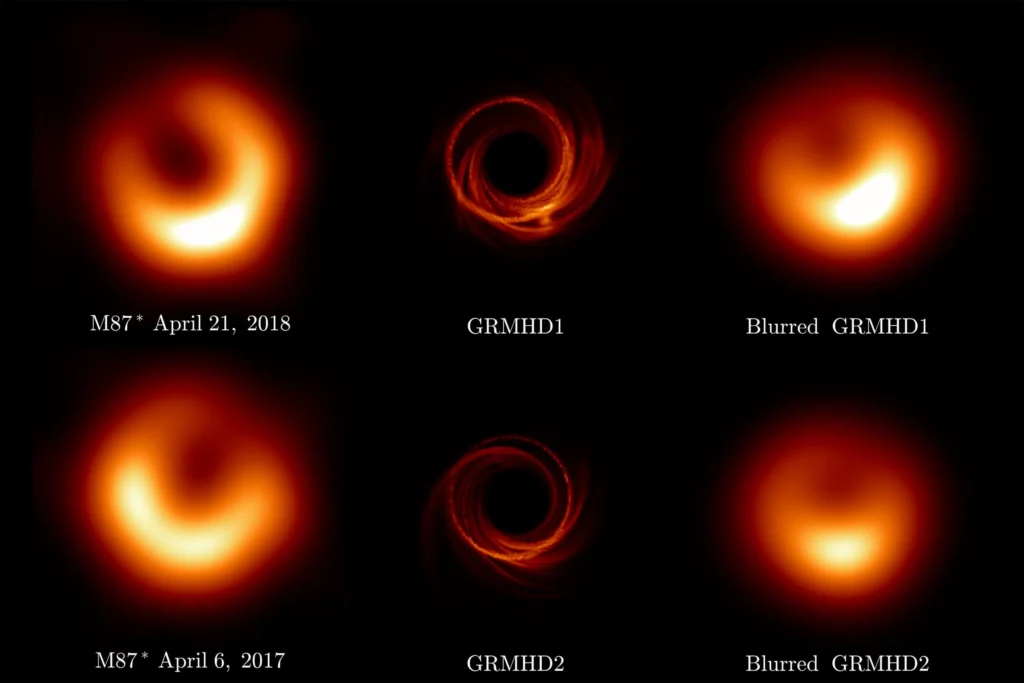
- Supermassive Black Holes: Found at galaxy centers, like Sagittarius A* in the Milky Way (4 million solar masses). Some reach billions of solar masses.
- Intermediate-Mass Black Holes: Rare, with masses between stellar and supermassive thousands of solar masses.
- Primordial Black Holes (hypothetical): Tiny ones possibly formed in the Big Bang.
How Do Black Holes Form?
Most black holes form via stellar collapse. When a massive star runs out of nuclear fuel, its core implodes, creating a supernova explosion. The remnant collapses into a black hole if massive enough.
Supermassive black holes likely grew by merging smaller ones and accreting gas over cosmic time. Recent simulations show stable accretion disks even in turbulent environments.
Recent Black Hole Discoveries in 2025
2025 has been a groundbreaking year for black hole research:
- Evolving Quasars: Observations revealed that the relationship between UV and X-ray emissions in quasars has changed over billions of years, suggesting supermassive black hole environments evolve challenging 50-year-old assumptions.
- Record-Breaking Flares: The most distant and energetic black hole flare ever seen, equivalent to 10 trillion suns, erupted from a quasar 10 billion light-years away.
- Early Universe Growth: JWST confirmed a rapidly feeding supermassive black hole in a galaxy just 570 million years after the Big Bang.
- Advanced Simulations: Supercomputer models detailed gas flows around stellar-mass black holes, showing dense thermal disks stabilized by magnetic fields.
- Merger Insights: New data on galaxy mergers showed supermassive black holes have “selective feeding habits,” influenced by turbulence and timing.
These breakthroughs highlight how black holes shape galaxies and the universe’s evolution.
Black Holes and General Relativity
Einstein’s theory of general relativity predicts black holes perfectly. Gravitational waves from mergers (detected by LIGO) and images from the Event Horizon Telescope confirm this. Black holes bend spacetime, causing effects like time dilation time slows near the event horizon.
Common Myths About Black Holes
- They suck everything in like vacuums: No, their gravity is strong only close by. If our Sun became a black hole, Earth’s orbit wouldn’t change.
- Wormholes or portals: No evidence; they’re separate theoretical concepts.
- They destroy information: The “information paradox” remains debated, but Hawking radiation suggests black holes evaporate over time.
Why Study Black Holes?
Black holes test extreme physics, help map the universe, and reveal cosmic history. Future telescopes like the next-gen Event Horizon Telescope promise even sharper images.
Black holes remain one of astronomy’s greatest mysteries. With 2025’s exciting discoveries, we’re closer than ever to understanding these cosmic behemoths.
What do you think about black holes? Share your thoughts in the comments! For more on space mysteries, check out our guides to supermassive black holes and gravitational waves.