The Big Bang theory is the leading scientific explanation for the origin and evolution of the universe. It describes how the universe expanded from an extremely hot and dense state about 13.8 billion years ago. This isn’t about an “explosion” but the rapid expansion of space itself. In this guide, we’ll cover the essentials: what it is, key stages, evidence, and recent updates.
What Is the Big Bang Theory?
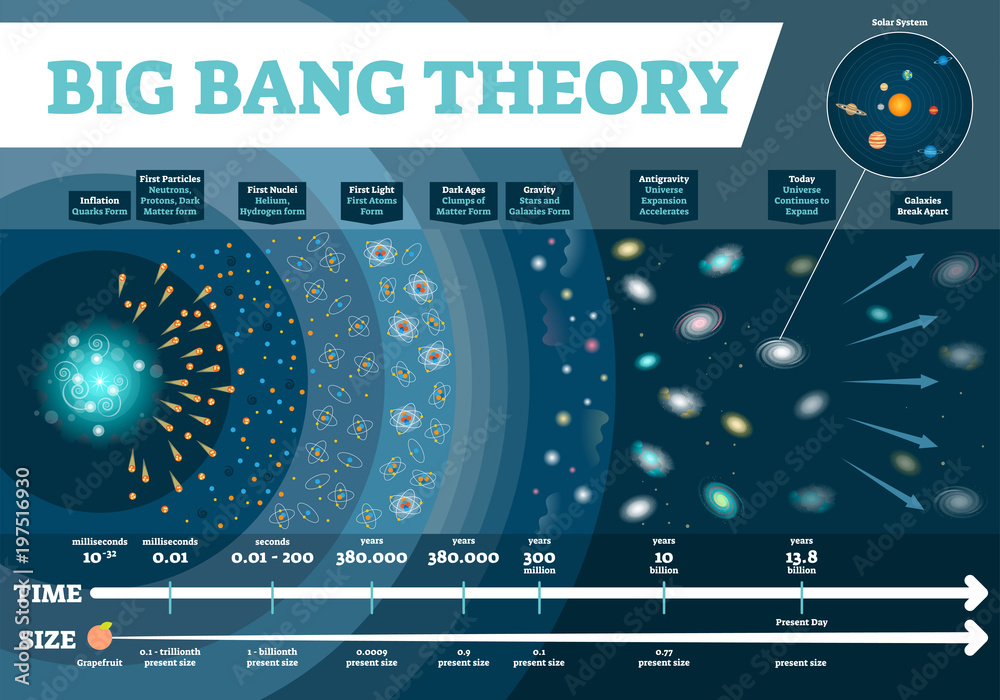
The Big Bang theory states that the universe began as a singularity an infinitely hot and dense point then expanded and cooled over time. Space, time, matter, and energy all emerged during this event.
- Common misconception: It wasn’t an explosion in empty space; the Big Bang created space itself.
- No “before”: Time began with the Big Bang, so asking what happened before doesn’t apply in current physics.
Key Stages of the Big Bang
- Singularity and Planck Epoch: The earliest moment where quantum gravity rules beyond current understanding.
- Cosmic Inflation: In a fraction of a second, the universe expanded exponentially, solving why it’s so uniform and flat.
- Quark-Gluon Plasma: Extreme heat forms fundamental particles.
- Nucleosynthesis: First few minutes light elements like hydrogen (75%) and helium (25%) form.
- Recombination (380,000 years): Universe cools; atoms form, releasing the Cosmic Microwave Background (CMB) radiation.
- Formation of Stars and Galaxies: Gravity clumps matter; first stars ignite hundreds of millions of years later.
Main Evidence for the Big Bang
- Universe Expansion: Galaxies move away from us (redshift), faster with distance Hubble’s Law.
- Cosmic Microwave Background: Leftover radiation at 2.7 K, discovered in 1965, with tiny fluctuations matching predictions.
- Element Abundances: Precise ratios of hydrogen, helium, and lithium from early nucleosynthesis.
- Large-Scale Structure: Galaxy distribution aligns with inflation-seeded fluctuations.
2025 Updates and Open Questions
James Webb Space Telescope (JWST) data shows unexpectedly bright, massive galaxies in the early universe, prompting refinements to formation timelines. The “Hubble tension” (varying expansion rate measurements) and roles of dark matter/energy continue to challenge and refine the theory.
The Big Bang remains the best-supported model, backed by decades of observations.
What part of the Big Bang theory intrigues you most? Share in the comments! For more, check our guides on universe formation or space facts.