Many assume outer space is uniformly freezing cold, but the reality is more extreme. Space has no single temperature it’s a vacuum with no air to conduct heat. Objects heat up or cool down based on radiation exposure. Deep space baselines near absolute zero, yet near stars, temperatures soar. This guide explores the extremes, from the Cosmic Microwave Background to sunlight in orbit.
Why Space Temperature Varies So Much
Vacuum insulates perfectly no convection or conduction. Heat transfers only via radiation:
- In direct sunlight: Objects absorb energy and heat rapidly.
- In shade: They radiate heat away, cooling toward absolute zero (-273°C / 0 K).
The baseline “temperature” of empty space is the Cosmic Microwave Background (CMB) radiation: a uniform 2.725 K (-270.425°C / -454.765°F) leftover glow from the Big Bang.
How Cold Can Space Get?
- Deep interstellar/intergalactic space (shade): Approaches 2.7 K, with some voids cooler (down to ~2 K).
- Record cold spots: Boomerang Nebula reaches ~1 K (-272°C) due to expanding gas.
- Absolute zero limit: Never reached naturally, but deep space is the coldest known environment.
Objects in perpetual shade (e.g., far from stars) slowly approach this baseline.
How Hot Can Space Get?
Near heat sources, temperatures spike:
- Earth orbit (sunlit side): Up to +120°C (+248°F) on unprotected surfaces.
- In shade (Earth orbit): Down to -160°C (-256°F).
- Near the Sun (Mercury-like): Day side ~430°C (800°F); night side plummets.
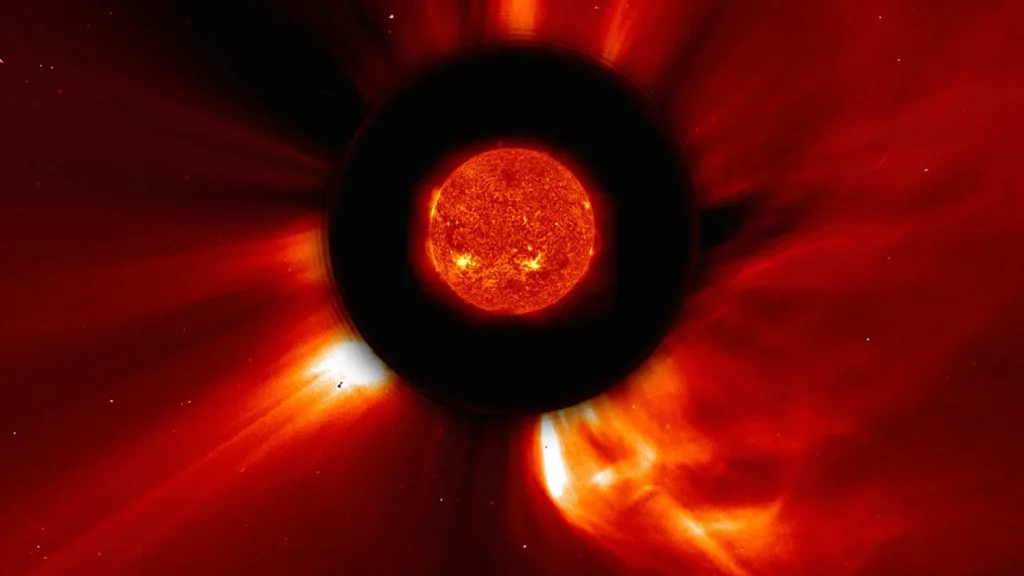
- Closer extremes: Parker Solar Probe withstands ~1,400°C near the Sun’s corona.
- Hottest natural spots: Gas near black holes or stellar surfaces reach millions of degrees.
Spacecraft use reflective coatings and radiators to manage these swings.
Quick Temperature Comparison
| Location/Condition | Approximate Temperature |
|---|---|
| Deep space baseline (CMB) | 2.7 K (-270°C / -454°F) |
| Earth orbit shade | -160°C to -100°C (-256°F to -148°F) |
| Earth orbit sunlight | +120°C (+248°F) |
| Lunar day surface | +120°C (+248°F) |
| Lunar night surface | -170°C (-274°F) |
| Near Venus (cloud tops) | ~20–70°C (but surface 460°C) |
| Hottest (stellar coronas) | Millions of °C |
Space’s temperature extremes challenge spacecraft design engineers test in thermal vacuum chambers to mimic these conditions.