The history of China is one of the world’s oldest and most continuous civilizations, spanning over 5,000 years of innovation, empire-building, cultural brilliance, and dramatic transformations. Often called the “Cradle of Eastern Civilization,” China has shaped global history through inventions, philosophy, and resilience. Whether you’re exploring a China history timeline, key events in Chinese history, or iconic landmarks, this journey reveals how ancient traditions meet modern might.
Ancient Origins and Imperial Glory
China’s story begins with legendary Xia Dynasty (c. 2070 BCE), followed by the Shang (c. 1600–1046 BCE) known for oracle bones and bronze work.
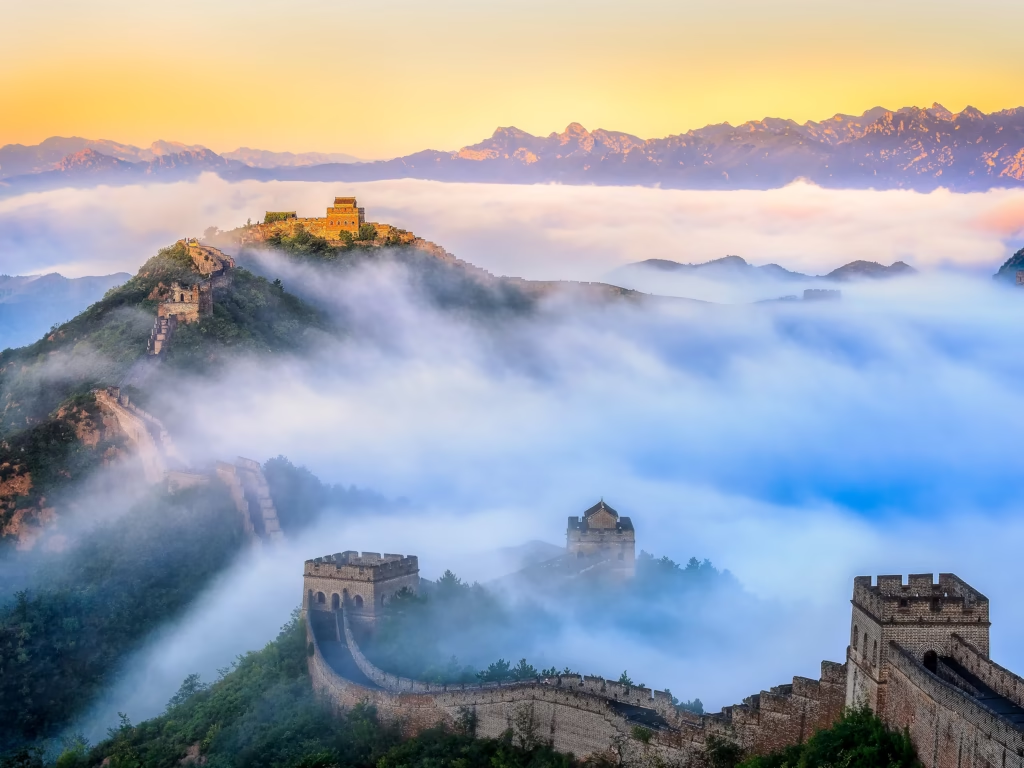
The Qin Dynasty (221–206 BCE) unified China under Emperor Qin Shi Huang, building the early Great Wall to defend against invaders.
The iconic Great Wall, expanded over centuries, symbolizes China’s enduring strength.
His tomb guards the famous Terracotta Army thousands of life-sized warriors discovered in 1974.
This archaeological wonder showcases ancient craftsmanship.
The Han Dynasty (206 BCE–220 CE) opened the Silk Road, spreading silk, tea, and ideas. China gifted the world the Four Great Inventions: papermaking, gunpowder, printing, and the compass.
These revolutionized global trade and knowledge.
Later dynasties like Tang (618–907) and Song (960–1279) brought poetry, art, and prosperity, while the Ming (1368–1644) constructed the magnificent Forbidden City in Beijing.
This vast palace complex housed emperors for nearly 500 years.
Turbulence and Foreign Influence
The Qing Dynasty (1644–1912), China’s last imperial rule, expanded territory but faced Western pressures. The Opium Wars led to unequal treaties and “century of humiliation.”
The 1911 Revolution ended monarchy, founding the Republic of China under Sun Yat-sen.
Revolution and the People’s Republic
Civil war and Japanese invasion (1937–1945) ravaged the nation. In 1949, Mao Zedong proclaimed the People’s Republic of China from Tiananmen Square, marking communist victory.
This pivotal moment reshaped modern China.
The Mao era included the Great Leap Forward and Cultural Revolution, followed by Deng Xiaoping’s 1978 reforms opening China to the world.
Modern China: Rise to Power
Today, China is an economic giant, with futuristic cities like Shanghai’s dazzling skyline.
Shanghai’s night views represent China’s rapid modernization and global influence.
From high-speed rails to space missions, China blends ancient heritage with cutting-edge innovation.
Fun Facts from Chinese History
- The Great Wall is over 13,000 miles long visible from space? (Myth, but impressive!)
- Confucius’ teachings have influenced East Asia for 2,500 years.
- China invented ice cream, football (cuju), and fireworks.
The history of China captivates with its depth, from imperial splendor to revolutionary change and contemporary dominance. It’s a testament to endurance and adaptation. Which era of China’s past fascinates you most? Share in the comments!