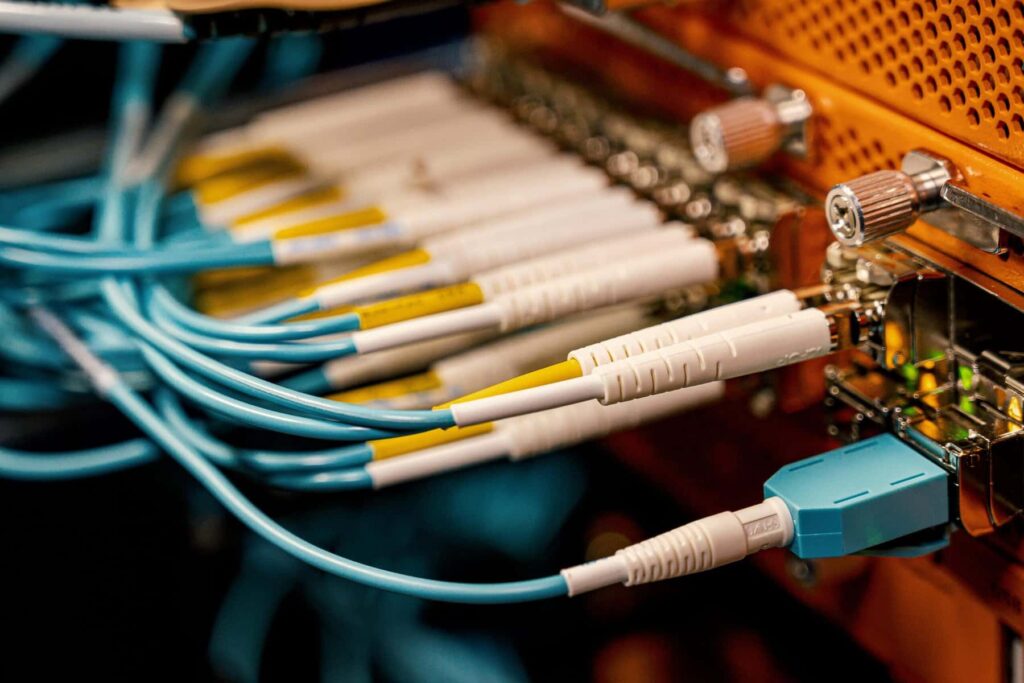
In today’s digital world, high-speed and reliable internet is essential. Fiber optic cables revolutionize data transmission by using light to carry information, offering unmatched speed, bandwidth, and reliability compared to traditional copper cables. This comprehensive guide covers what fiber optic cables are, how they work, their benefits, types, installation, and more.
What Is a Fiber Optic Cable?
A fiber optic cable consists of thin strands of glass or plastic (optical fibers) that transmit data as pulses of light. Unlike copper cables that use electrical signals, fiber optics rely on light reflection to send information over long distances with minimal loss.
Basic Structure of a Fiber Optic Cable
Key components include:
- Core — The central part where light travels (typically 8-62.5 microns thick).
- Cladding — Surrounds the core and reflects light back in via total internal reflection.
- Buffer Coating — Protects the fiber from moisture and damage.
- Jacket — Outer layer for overall protection.

How Do Fiber Optic Cables Work?
Data converts to light pulses (using lasers or LEDs), travels through the core by bouncing off the cladding, and converts back to electrical signals at the receiving end. This enables speeds up to 100 Gbps or more with very low latency.
Types of Fiber Optic Cables
Two main types dominate:
Single-Mode vs. Multimode Fiber Optic Cables
| Feature | Single-Mode Fiber (SMF) | Multimode Fiber (MMF) |
|---|---|---|
| Core Diameter | 8-10 microns | 50-62.5 microns |
| Light Source | Laser | LED or VCSEL |
| Distance | Up to 100+ km (long-haul) | Up to 2 km (short distances) |
| Bandwidth/Speed | Higher (ideal for telecom) | Good for data centers/LANs |
| Cost | Higher (due to precise lasers) | Lower |
| Common Use | Long-distance internet, telecom backbones | Indoor networks, campuses |
Other classifications include indoor, outdoor, aerial, underground, and armored cables.
Advantages of Fiber Optic Cables
- Blazing Fast Speeds → Up to 100 Gbps+ for seamless streaming, gaming, and downloads.
- High Bandwidth → Handles massive data volumes without slowdowns.
- Long Distance Transmission → Minimal signal loss over kilometers.
- Immunity to Interference → No electromagnetic interference (EMI) unlike copper.
- Security → Harder to tap without detection.
- Lightweight and Thin → Easier to handle and install in tight spaces.
- Future-Proof → Supports emerging tech like 5G, IoT, and smart cities.
Disadvantages
- Higher initial installation costs.
- Fragility (requires careful handling to avoid bends or breaks).
- Needs specialized tools and skilled technicians for splicing/termination.
Fiber Optic Cable Installation Guide
Proper installation is crucial for performance.
Common methods:
- Underground — Buried in conduits for protection (most durable).
- Aerial — Hung on poles (cost-effective for rural areas).
- Indoor — Routed through walls/trays in buildings.
Steps include site survey, planning routes, pulling/blowing cables, splicing, and testing (using OTDR tools).
In 2026, trends focus on easier pre-terminated cables and automated management for faster deployments.
Why Choose Fiber Optic Cables in 2026?
With exploding data demands from AI, 8K streaming, and remote work, fiber optic cables remain the gold standard for reliable, high-speed connectivity. Whether for home internet, data centers, or telecom networks, they offer superior performance that copper can’t match.