The Sun is a massive star located at the center of the solar system. It provides the energy that supports life on Earth and governs the motion of planets through its immense gravity.
Size and Composition of the Sun
The Sun accounts for about 99.8 percent of the total mass of the solar system. Its diameter is approximately 1.39 million kilometers, which means more than one million Earths could fit inside it.
The Sun is composed mainly of hydrogen and helium. Through nuclear fusion, hydrogen atoms combine to form helium, releasing enormous amounts of energy.
Layers of the Sun
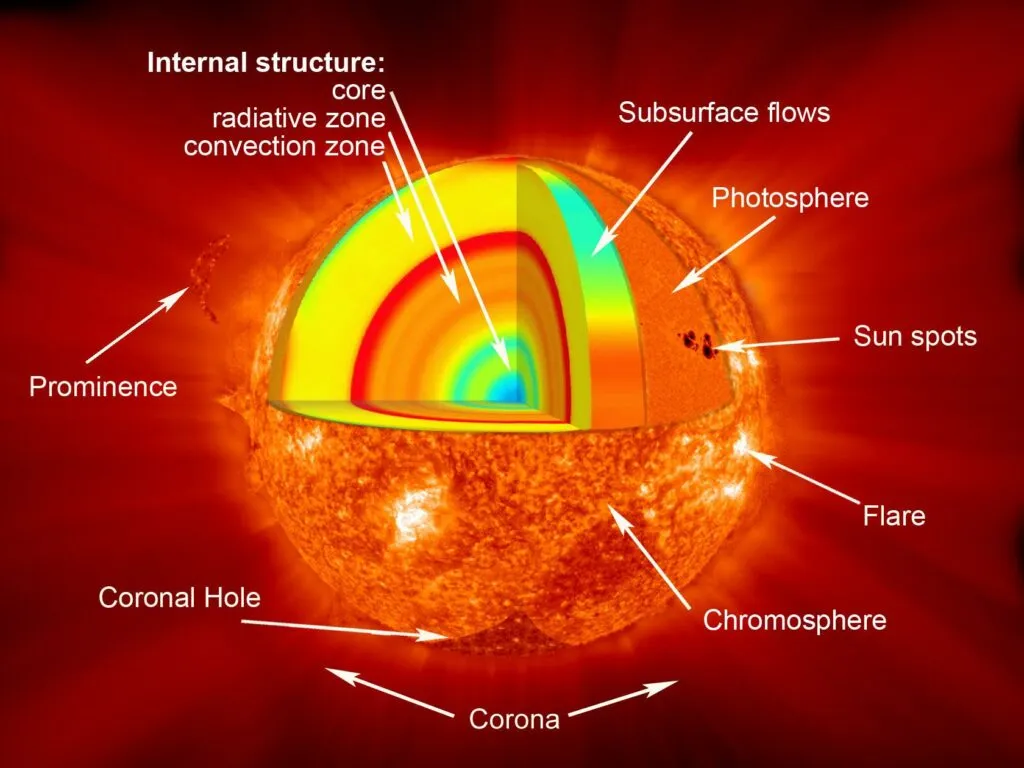
The Sun has several layers:
- Core, where nuclear fusion occurs
- Radiative zone, where energy moves outward
- Convective zone, where hot plasma rises and cool plasma sinks
- Photosphere, the visible surface
- Chromosphere and corona, the outer atmospheric layers
The corona can reach temperatures of over one million degrees Celsius.
Solar Energy and Light
Energy from the Sun takes about eight minutes to reach Earth. This sunlight drives photosynthesis, weather systems, and the global climate.
Without the Sun, Earth would become a frozen, lifeless world.
Solar Activity
The Sun experiences an 11 year solar cycle characterized by changes in magnetic activity. During periods of high activity, solar flares and coronal mass ejections can occur.
These events can:
- Disrupt satellites
- Affect radio communications
- Create auroras near Earth’s poles
The Sun’s Role in Time and Seasons
Earth’s tilt and orbit around the Sun create seasons. The Sun has also been used throughout history to measure time, from ancient sundials to modern calendars.
Future of the Sun
The Sun is about 4.6 billion years old and is expected to continue shining for another 5 billion years before becoming a red giant.
The Sun is a powerful and essential star that shapes every aspect of life on Earth and the structure of the solar system.