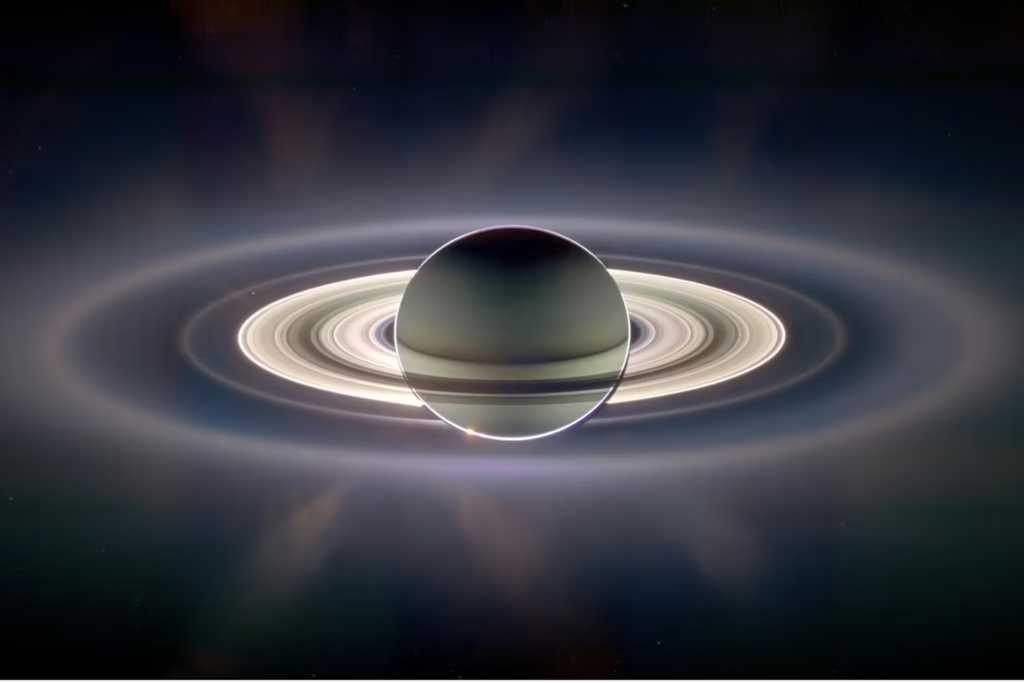
Saturn, the sixth planet from the Sun, is often called the “jewel of the solar system” due to its stunning ring system. These rings make Saturn one of the most visually captivating planets, visible even through small telescopes. Composed primarily of water ice particles mixed with rocky dust, the rings reflect sunlight brilliantly, creating a spectacle that has fascinated astronomers for centuries. In 2025, observations confirmed that Saturn’s rings are gradually disappearing due to “ring rain,” where particles fall into the planet’s atmosphere.
What Are Saturn’s Rings Made Of?
Saturn’s rings are made up of billions of particles, ranging from tiny dust grains to mountain-sized chunks. About 99.9% of these are pure water ice, with trace amounts of rocky material and organic compounds like tholins. The particles are coated in dust, giving the rings a bright, white appearance when viewed from Saturn’s cloud tops. Unlike solid structures, the rings are incredibly thin spanning up to 175,000 miles (282,000 km) wide but only about 30 feet (10 meters) thick in most areas.
NASA’s Cassini mission (2004–2017) provided the most detailed insights, revealing that the rings formed from shattered comets, asteroids, or moons torn apart by Saturn’s gravity. Recent data from 2025 shows the rings are relatively young, estimated at 10–100 million years old.
The Structure and Divisions of the Rings
Saturn’s ring system is divided into several main sections: A, B, C, D, E, F, and G rings. The brightest are A and B, separated by the Cassini Division—a 3,000-mile gap caused by gravitational interactions with Saturn’s moons. The faint E ring is fed by water jets from the moon Enceladus, discovered by Cassini.
Each ring orbits at different speeds, creating wave patterns and ringlets. Close-up images show millions of these tiny bands, making the system far more complex than any other planet’s.
Why Are Saturn’s Rings So Beautiful?
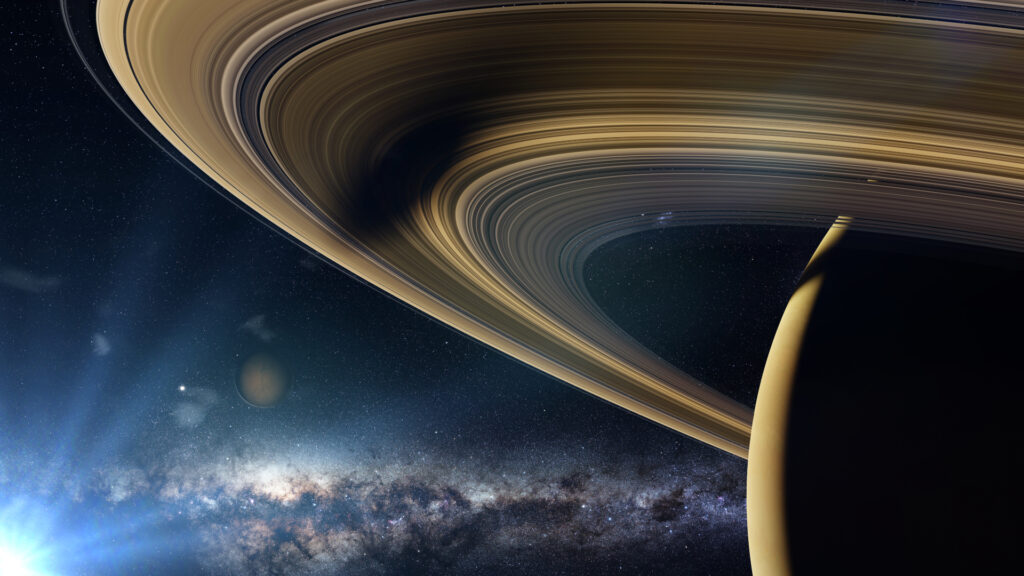
The beauty comes from their reflectivity and intricate details. The ice particles scatter sunlight, making the rings shine brighter than the planet itself. From Earth, they appear as elegant bands encircling Saturn’s golden-yellow atmosphere. During equinox events (like in 2025), sunlight hits the rings edge-on, revealing shadows and hidden structures.
Cassini captured extraordinary views, including moon-ring interactions and the lowest ring temperatures ever recorded. The rings’ purity and vast scale evoke wonder, often described as the solar system’s most ornamental feature.
Discoveries and Observations
Galileo first spotted the rings in 1610, mistaking them for “ears.” Christiaan Huygens identified them as a disk in 1655. Modern missions like Voyager and Cassini revealed their dynamic nature—particles clump, form spokes, and interact with moons like Prometheus, which creates kinks in the F ring.
In 2025, Hubble and ground-based telescopes continue monitoring the rings’ slow demise, with particles raining down at a “worst-case” rate, potentially vanishing in 100–300 million years.
The Future of Saturn’s Rings
While Saturn will lose its iconic rings over cosmic timescales, they remain spectacular today. Future missions may explore their origins further. For stargazers, Saturn is best viewed in opposition, when it’s brightest in the night sky.