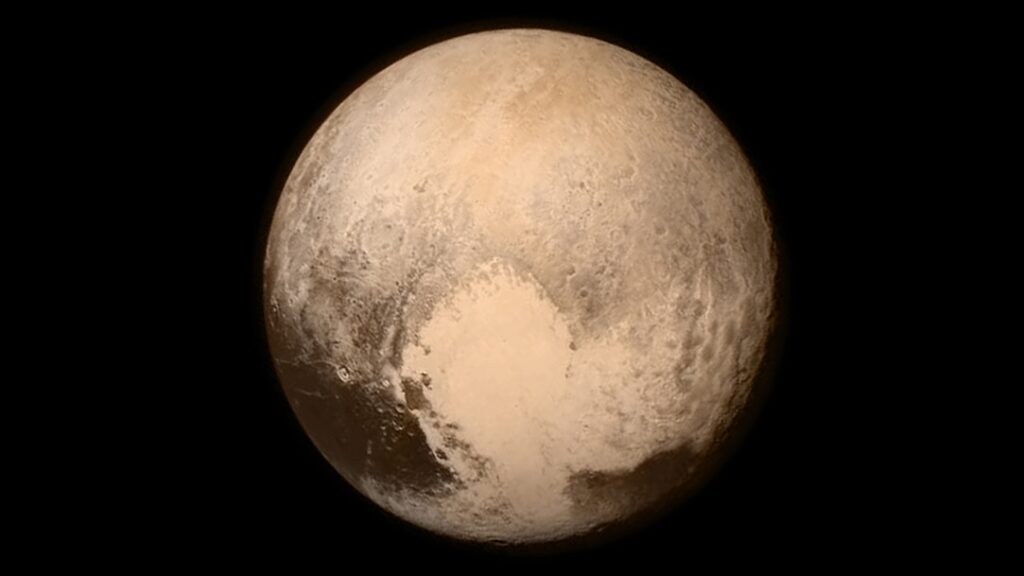
A dwarf planet is a celestial body that orbits the Sun and is massive enough for gravity to make it nearly round, but unlike major planets, it has not cleared debris from its orbital path.
The most famous dwarf planet is Pluto, but several others exist, including Eris, Haumea, Makemake, and Ceres.
Pluto Is Not Alone
For decades Pluto was considered the ninth planet. In 2006, astronomers reclassified it as a dwarf planet after discovering many similar objects beyond Neptune.
The Kuiper Belt and the more distant scattered disk contain countless icy bodies, some of which may rival Pluto in size.
Strange Shapes and Rapid Spins
Not all dwarf planets are spherical. Haumea is shaped more like a stretched football because it spins once every four hours, incredibly fast for an object of its size.
Icy Volcanoes and Hidden Oceans
Some dwarf planets show signs of cryovolcanism, meaning volcano-like features that erupt water, ammonia, or methane instead of molten rock. Pluto’s surface contains vast nitrogen glaciers, while Ceres has bright salt deposits that hint at underground briny reservoirs.
These discoveries raise exciting questions about whether dwarf planets might once have been geologically active or even capable of supporting microbial life in subsurface oceans.
Moons of Dwarf Planets
Many dwarf planets have moons. Pluto has five, including its massive companion Charon, which is so large relative to Pluto that the two bodies orbit a point in space between them.
Eris and Haumea also possess small moons that help astronomers calculate their mass and density.
Why Dwarf Planets Are Important
Dwarf planets are ancient leftovers from the Solar System’s formation. Studying them gives scientists clues about:
- How planets originally formed
- The composition of early solar material
- Conditions in the distant outer regions
As telescopes improve, astronomers expect to discover many more dwarf planets in the future.