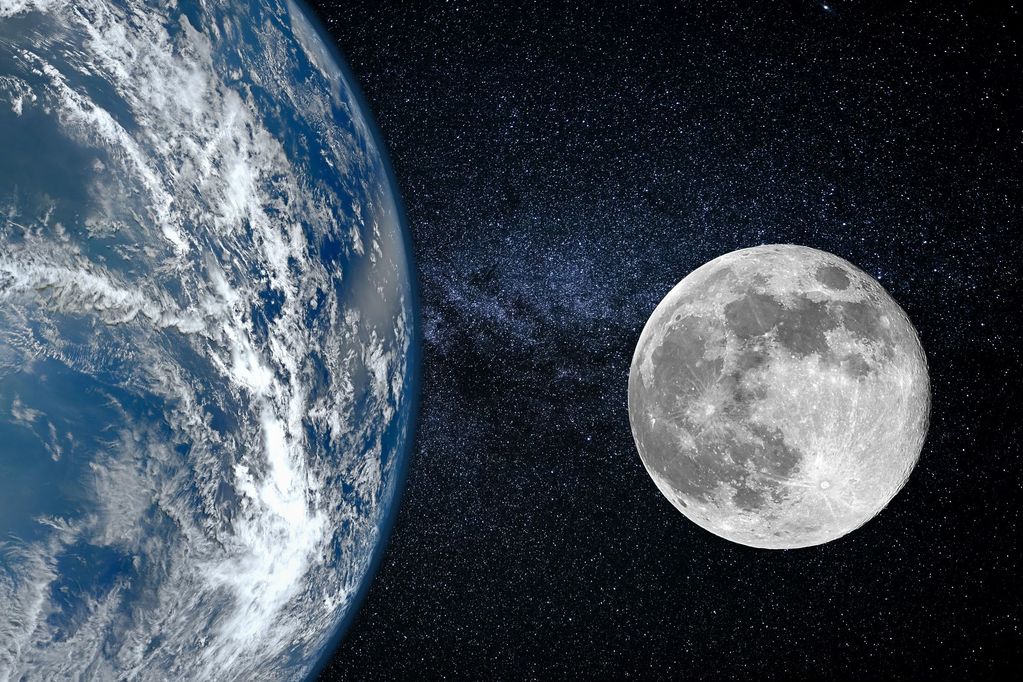
The Moon has orbited Earth for more than four billion years, shaping our planet in ways that go far beyond its gentle glow in the night sky. From driving ocean tides to stabilizing Earth’s rotation, the Moon plays a vital role in making our world what it is today.
Formation of the Moon
The leading explanation for the Moon’s origin is the giant impact hypothesis. According to this theory, a Mars-sized object collided with the early Earth, ejecting debris into orbit that eventually coalesced into the Moon.
This event likely changed Earth’s rotation, tilted its axis, and influenced the development of continents and oceans.
Tides and Ocean حركة
One of the Moon’s most obvious effects is its gravitational pull on Earth’s oceans, creating high and low tides. As Earth rotates, different regions pass through tidal bulges, producing regular cycles that affect coastal ecosystems, navigation, and even marine life reproduction.
The Sun also influences tides, but the Moon’s proximity makes it the dominant factor.
Stabilizing Earth’s Axis
Earth’s axial tilt is responsible for our seasons. The Moon helps stabilize this tilt, preventing wild fluctuations that could cause extreme climate changes. Without the Moon, Earth’s climate might swing dramatically over millions of years, making it far less hospitable for complex life.
Slowing Earth’s Rotation
Over time, the Moon is gradually slowing Earth’s spin through tidal friction. This means days on Earth are becoming slightly longer every century, while the Moon slowly drifts farther away.
Billions of years ago, a day on Earth may have lasted only a few hours.
Cultural and Biological Influence
Throughout history, humans have used the Moon to measure time, guide agriculture, and inspire mythology and art. Many organisms also respond to lunar cycles, including corals that synchronize mass spawning events with specific moon phases.
Future of the Earth-Moon System
In the distant future, Earth and the Moon will continue to evolve together. The Moon will slowly move outward, and Earth’s rotation will continue to slow, reshaping tides and possibly climate patterns over geological time scales.