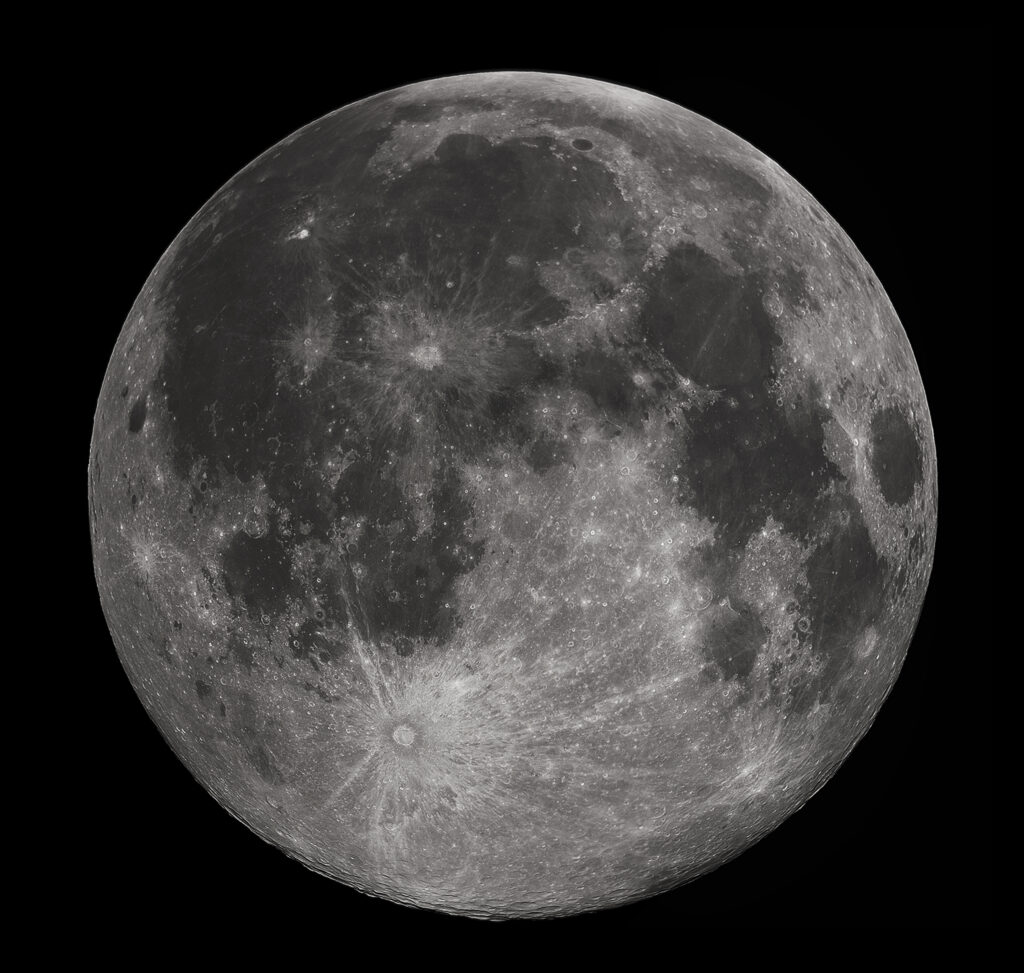
The Moon does not produce its own light, yet it often dominates the night sky. Its silvery glow has fascinated humans for thousands of years, inspiring stories, calendars, and scientific inquiry. Understanding why the Moon shines requires exploring sunlight, surface properties, and orbital motion.
Reflected Sunlight, Not Emitted Light
The Moon shines because it reflects light from the Sun. Its surface is covered in dusty rock called regolith, which scatters incoming sunlight in many directions. Although the Moon looks bright, it actually reflects only about 12 percent of the sunlight that hits it, making it darker than fresh asphalt.
Phases of the Moon Explained
As the Moon orbits Earth, we see different portions of its sunlit side, producing phases such as:
- New Moon
- First Quarter
- Full Moon
- Last Quarter
These phases are not caused by Earth’s shadow except during rare lunar eclipses.
Why the Full Moon Looks So Bright
During a full Moon, the Earth lies roughly between the Sun and the Moon, allowing us to see the entire illuminated face. The brightness is enhanced by a phenomenon called the opposition effect, where shadows on the Moon’s rough surface disappear, making it appear slightly brighter than usual.
Color Changes and Atmospheric Effects
Sometimes the Moon appears yellow, orange, or red when it is low on the horizon. This happens because Earth’s atmosphere scatters shorter blue wavelengths of light, allowing redder light to reach our eyes.
During a total lunar eclipse, the Moon can turn deep red as sunlight filtered through Earth’s atmosphere bends toward it, creating the famous “blood moon” effect.
Does the Moon Ever Glow on Its Own
The Moon does not generate visible light like a star, but it can emit faint infrared radiation due to absorbed heat. There is also a subtle phenomenon called earthshine, when sunlight reflected off Earth softly illuminates the Moon’s dark portion.
Why Moonlight Matters
Moonlight has influenced navigation, nocturnal animal behavior, and human culture for millennia. Before artificial lighting, the full Moon provided crucial nighttime illumination for travel and work.
Conclusion: A Reflection That Shapes Our World
The Moon’s glow is a simple yet powerful reminder of our planet’s place in space. By reflecting sunlight and interacting gravitationally with Earth, the Moon continues to shape both our nights and our planet’s long-term evolution.