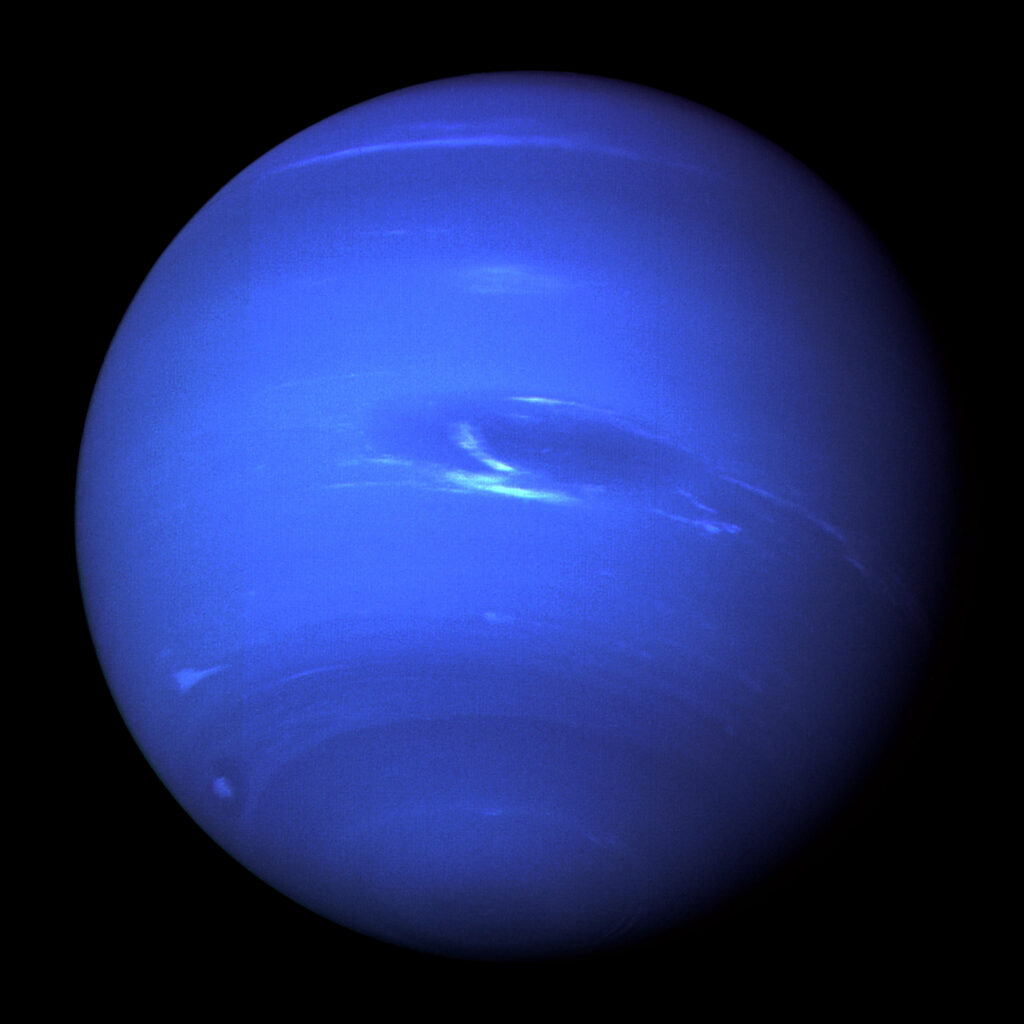
Neptune is the eighth and farthest known planet from the Sun, famous for its deep blue color and unbelievably violent weather. Despite being more than 4.5 billion kilometers away from Earth, Neptune continues to fascinate astronomers because of its powerful storms, icy composition, and supersonic winds. Among all planets in our Solar System, Neptune holds the record for the fastest atmospheric winds ever observed.
Discovery and Basic Characteristics
Neptune was discovered in 1846 after mathematicians predicted its position based on disturbances in Uranus’ orbit. It is classified as an ice giant, along with Uranus, because much of its interior is composed of water, ammonia, and methane ices rather than hydrogen and helium alone.
Key traits include:
- Diameter of about 49,244 kilometers
- A day lasting roughly 16 hours
- A year equal to 165 Earth years
- An average temperature near minus 214 degrees Celsius
Why Is Neptune So Windy
Scientists have measured winds on Neptune traveling at over 2,000 kilometers per hour, far faster than the strongest hurricanes on Earth. This is surprising because Neptune receives very little sunlight compared to inner planets.
Researchers believe the extreme winds come from a combination of:
- Heat rising from Neptune’s interior
- Rapid rotation
- Complex atmospheric chemistry
Unlike Earth, where the Sun drives most weather systems, Neptune seems to generate much of its storm energy internally.
Storm Systems and the Great Dark Spots
Neptune is known for enormous storms called Great Dark Spots, similar in concept to Jupiter’s Great Red Spot. These storms can grow as large as Earth and then vanish after only a few years, indicating a dynamic and constantly changing atmosphere.
Bright white clouds made of frozen methane crystals often appear around these storms, racing through the atmosphere at incredible speeds.
Composition and Internal Structure
Beneath Neptune’s thick clouds lies a mantle of superheated water, ammonia, and methane under immense pressure. At the center is believed to be a rocky core roughly the size of Earth.
Its blue color comes from methane gas in the upper atmosphere, which absorbs red light and reflects blue wavelengths back into space.
Moons and Rings
Neptune has more than a dozen known moons, the largest being Triton, which orbits in the opposite direction of Neptune’s rotation. This unusual orbit suggests Triton was likely captured from the Kuiper Belt.
The planet also has faint ring systems made of dust and ice, though they are much harder to see than Saturn’s famous rings.
Why Neptune Matters to Science
Studying Neptune helps scientists understand:
- How ice giants form
- Weather systems under extreme conditions
- Planets in distant star systems with similar sizes
Because Neptune-like exoplanets appear to be common across the galaxy, learning more about this icy world improves our broader knowledge of planetary evolution.