Asteroids, rocky solar system relics, have impacted Earth throughout history, shaping life and landscapes. The question of whether they can hit us again is not if, but when and how we prepare. This exploration delves into risks, past events, and mitigation strategies.
Understanding Asteroids Sizes, Orbits, and Threats
Asteroids vary from pebbles to mountains, orbiting the Sun mostly in the main belt but some as NEAs with Earth-crossing paths. Classified by orbit: Apollos cross Earth’s, Atens inside, Amors outside.
Potentially Hazardous Asteroids (PHAs) are over 140 meters, approaching within 0.05 AU. NASA’s Near-Earth Object Observations Program tracks 30,000+ NEAs, with 2,300 PHAs. Small ones burn up; larger cause devastation.
Historical Impacts: Evidence from the Past
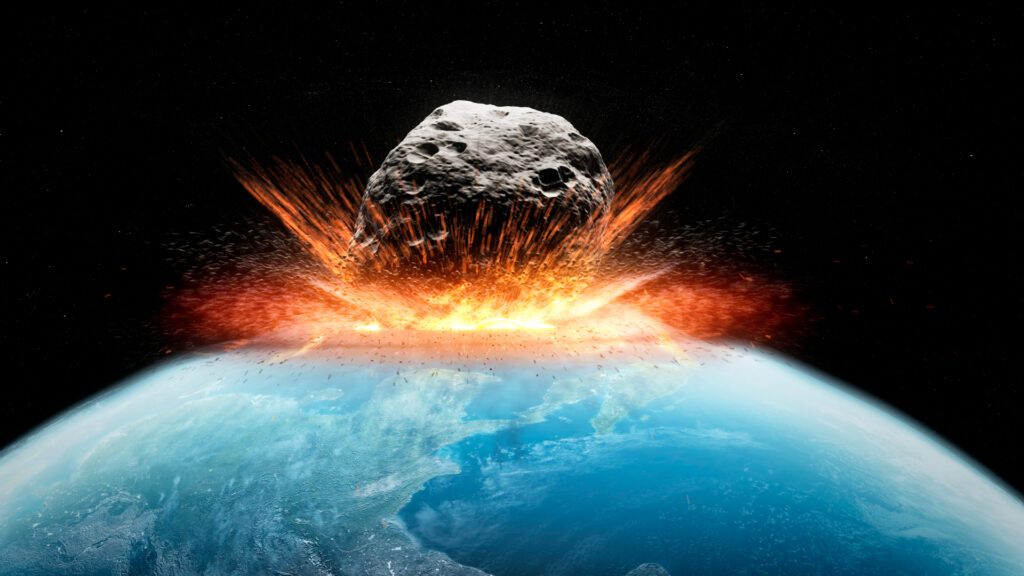
The Chicxulub impact 66 million years ago, a 10-15 km asteroid, caused dinosaur extinction via global fires, tsunamis, and nuclear winter. The 1908 Tunguska event flattened 2,000 km² in Siberia from a 50-100 meter airburst.
Recent: 2013 Chelyabinsk meteor, 20 meters, injured 1,500 with shockwaves. Meteor Crater in Arizona, from a 50-meter iron asteroid 50,000 years ago, spans 1.2 km. These underscore ongoing threats.
Probability and Risk Assessment
Odds of a major impact are low: a 1-km asteroid hits every 500,000 years, per NASA. Torino Scale rates threats; most are 0. Sentry monitors, like Apophis (once high risk, now safe past 2029).
Small asteroids hit frequently but harmlessly. Climate change from large impacts includes dust blocking sunlight, acid rain. Modeling predicts regional vs. global effects based on size.
Detection and Monitoring Efforts
Telescopes like NEOWISE and upcoming NEO Surveyor scan skies. International Astronomical Union coordinates. Amateur networks contribute.
AI enhances detection, analyzing data for anomalies. Ground-based radars like Arecibo (pre-collapse) and Goldstone characterize orbits and shapes.
Deflection Strategies: Protecting Our Planet
Planetary defense includes kinetic impactors, like NASA’s DART mission (2022) successfully altering Dimorphos’ orbit. Nuclear options involve standoff explosions to nudge asteroids.
Gravity tractors use spacecraft mass to pull slowly. Ion beams or lasers ablate surfaces for thrust. International exercises simulate responses.
Future Challenges and Ethical Considerations
Undetected asteroids remain a risk; only 40% of 140m+ NEAs are known. Space mining could alter orbits unintentionally. Public communication avoids panic.
Collaborations like UN’s International Asteroid Warning Network prepare globally. As technology advances, we mitigate what once doomed dinosaurs.