The Sun, that glowing orb in our sky, is more than just a daily riser and setter—it’s a yellow dwarf star at the heart of our solar system. Classified as a G-type main-sequence star, or yellow dwarf, the Sun is a fascinating celestial body that sustains life on Earth while exemplifying the typical life of stars in the universe. In this article, we’ll dive into what makes the Sun a yellow star, its composition, life cycle, and its critical role in our existence. Whether you’re an astronomy enthusiast or just curious about the cosmos, understanding the Sun reveals the wonders of stellar science.
What Defines a Yellow Dwarf Star?
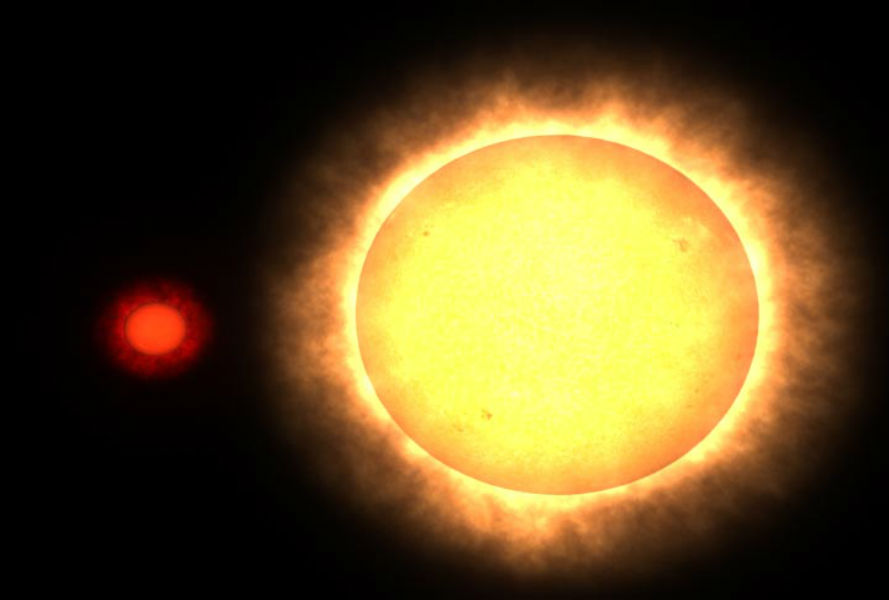
Yellow dwarf stars like the Sun are medium-sized stars in the main sequence phase of their lives. The term “dwarf” might sound small, but in astronomical terms, it refers to stars that aren’t giants or supergiants. The Sun has a surface temperature of about 5,500 degrees Celsius (9,932 degrees Fahrenheit), which gives it that characteristic yellow hue when viewed from Earth. This color comes from the blackbody radiation spectrum, where hotter stars appear blue-white and cooler ones reddish.
Astronomers classify stars using the Hertzsprung-Russell diagram, plotting luminosity against temperature. Yellow dwarfs fall in the G spectral class, with the Sun specifically as G2V. Compared to red dwarfs, which are smaller and cooler, or blue giants, which burn hotter and brighter but shorter-lived, yellow dwarfs strike a balance. They have masses between 0.8 and 1.2 times that of the Sun, allowing for stable fusion over billions of years. The Sun’s mass is approximately 1.989 × 10^30 kilograms, making it 333,000 times heavier than Earth.
The Composition and Structure of the Sun
At its core, the Sun is a massive ball of plasma, primarily composed of hydrogen (about 74%) and helium (24%), with trace amounts of heavier elements like oxygen, carbon, and iron. This composition is a remnant from the Big Bang and subsequent stellar nucleosynthesis. The Sun’s structure is layered: the core, where nuclear fusion occurs; the radiative zone, where energy travels via radiation; the convective zone, with rising and falling plasma currents; and the photosphere, the visible surface.
Nuclear fusion in the core converts hydrogen into helium, releasing immense energy through Einstein’s E=mc². Every second, the Sun fuses 620 million metric tons of hydrogen, producing energy equivalent to billions of nuclear bombs. This energy takes thousands of years to reach the surface due to the dense interior. The photosphere features sunspots—cooler, magnetic regions—and solar flares, which are bursts of radiation that can affect Earth’s technology.
The corona, the Sun’s outer atmosphere, extends millions of kilometers and is surprisingly hotter than the surface, reaching over a million degrees Celsius. This puzzle, known as the coronal heating problem, is still under study by missions like NASA’s Parker Solar Probe.
The Life Cycle of Our Yellow Star
The Sun formed about 4.6 billion years ago from a collapsing molecular cloud. It’s currently in its main sequence phase, where it will remain for another 5 billion years. As a yellow dwarf, its life is relatively calm compared to massive stars that end in supernovae.
In its future, the Sun will exhaust its hydrogen, expand into a red giant, engulfing inner planets like Mercury and Venus, and possibly scorching Earth. Eventually, it will shed its outer layers, leaving a white dwarf core—a dense, Earth-sized remnant that cools over trillions of years. This evolution highlights why yellow dwarfs are ideal for life: their longevity allows planets time to develop complex ecosystems.
The Sun’s Vital Role in Sustaining Life on Earth
Without the Sun, life as we know it wouldn’t exist. It provides heat, light, and energy for photosynthesis, driving Earth’s food chain. The Sun’s gravity keeps planets in orbit, maintaining the solar system’s stability. Solar wind, a stream of charged particles, creates the heliosphere, shielding us from cosmic rays.
However, the Sun can be hazardous. Solar storms disrupt satellites, power grids, and communications, as seen in the 1859 Carrington Event. Modern society relies on space weather forecasting to mitigate these risks. Culturally, the Sun has been worshipped in ancient civilizations, from Egyptian Ra to Aztec Tonatiuh, symbolizing life and power.
Exploring the Sun: Missions and Discoveries
Space agencies have launched probes like SOHO and SDO to study the Sun up close. These reveal details about solar oscillations, helping model its interior. Recent findings include the Sun’s differential rotation—faster at the equator than poles—and its 11-year activity cycle.
In summary, the Sun as a yellow dwarf star is a cornerstone of astronomy. Its balanced properties make it a model for understanding stellar evolution and habitability. As we continue to probe its secrets, we gain insights into our place in the universe.