Black holes, enigmatic voids where gravity reigns supreme, captivate scientists and the public alike. Predicted by general relativity, they form from collapsed stars or primordial events, warping spacetime. This in-depth exploration covers types, formation processes, detection, and theoretical implications, shedding light on these cosmic phenomena.
Stellar-Mass Black Holes: Born from Dying Stars
Stellar black holes, 3-20 solar masses, form when massive stars (over 8 solar masses) exhaust fuel. Core collapse triggers a supernova, compressing remnants below the Schwarzschild radius, where escape velocity exceeds light speed.
The process: Hydrogen fusion ends, heavier elements form until iron, which absorbs energy. Collapse ensues, neutrons resist briefly (Tolman-Oppenheimer-Volkoff limit), but for massive cores, a singularity forms. Cygnus X-1, 15 solar masses, exemplifies this.
Supermassive Black Holes: Giants at Galactic Centers
Supermassive black holes (SMBHs), millions to billions of solar masses, lurk in galaxy cores. Sagittarius A* in the Milky Way is 4 million solar masses. Formation theories: Direct collapse of gas clouds in early universe or mergers of smaller holes.
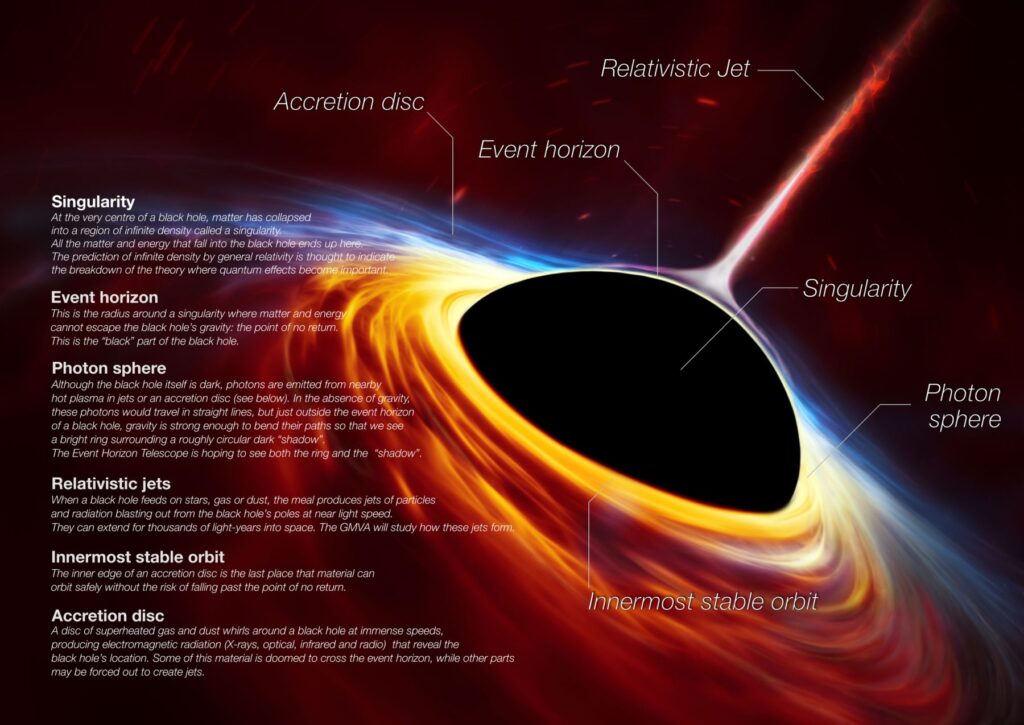
Seed black holes from Population III stars grow via accretion and mergers. Quasars, powered by accreting SMBHs, shine brighter than galaxies. Event Horizon Telescope imaged M87’s SMBH shadow.
Intermediate-Mass Black Holes: The Missing Link
Intermediate black holes (IMBHs), 100-100,000 solar masses, bridge stellar and supermassive. Form in dense clusters via runaway mergers or direct collapse.
Evidence from globular clusters like Omega Centauri. LIGO detected a 150 solar mass merger, suggesting IMBH origins. They may seed SMBHs.
Primordial Black Holes: Relics of the Big Bang
Primordial black holes (PBHs) formed in the universe’s first seconds from density fluctuations. Masses vary; small ones evaporate via Hawking radiation, larger persist.
PBHs could explain dark matter if asteroid-sized. Detection via microlensing or gamma bursts. JWST searches for early signatures.
The Physics of Formation: Gravity and Quantum Effects
General relativity describes collapse: Spacetime curves infinitely at singularity. Event horizon marks no-return point. Kerr metric accounts for spinning holes, with ergospheres.
Quantum gravity theories like loop quantum gravity suggest singularities resolve into “fuzzballs.” Hawking radiation predicts evaporation over eons.
Detection and Observation: Beyond the Invisible
Black holes betray presence via accretion disks hot gas spiraling in, emitting X-rays. Binary systems show orbital wobbles. Gravitational lensing bends light.
LIGO/Virgo detect mergers’ ripples. EHT’s images confirm predictions.
Theoretical Implications and Mysteries
Black holes challenge information paradox: Does evaporation destroy data? Holographic principle suggests info preserved on horizons.
They influence galaxy evolution, regulating star formation via jets. Wormholes and multiverses speculate connections.
Future: LISA will detect SMBH mergers, probing early universe.
In essence, black holes from stellar to primordial reveal gravity’s extremes, driving astrophysics forward. Their study unlocks cosmic secrets.