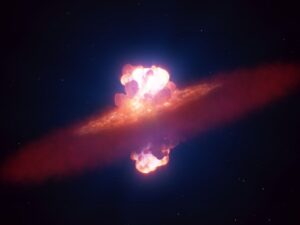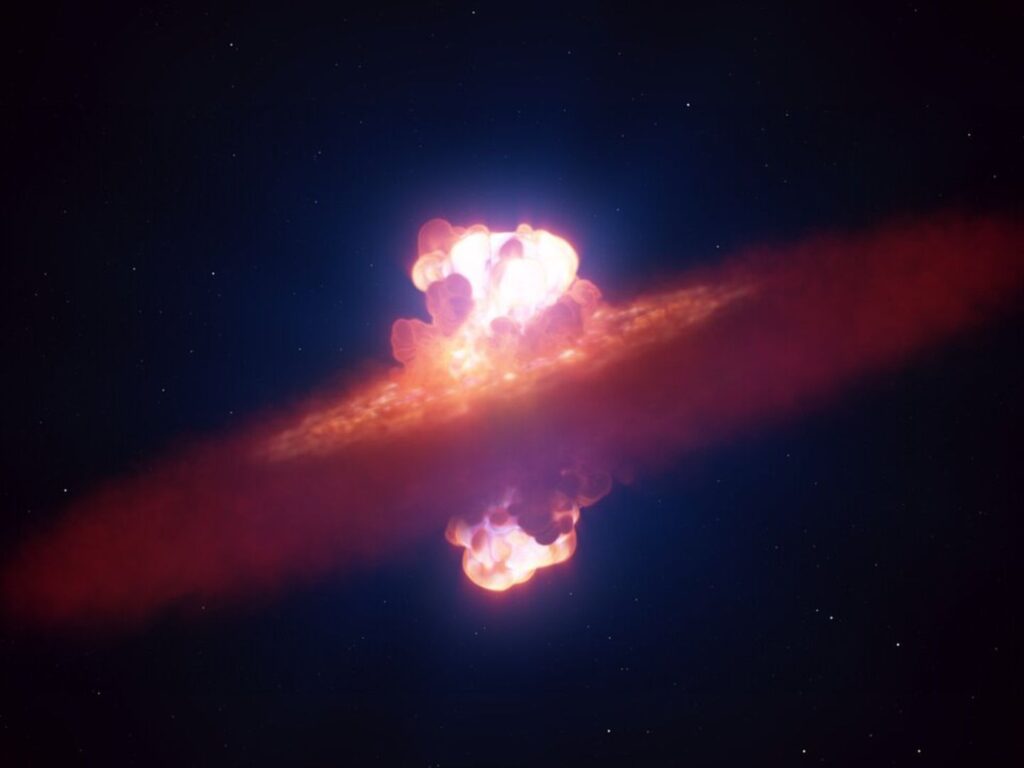
Supernovae, the cataclysmic deaths of stars, illuminate the cosmos with brilliance rivaling billions of suns. These explosions forge heavy elements, trigger star birth, and provide insights into universal expansion. This comprehensive article examines types, mechanisms, famous events, and broader impacts, offering a detailed view of these stellar spectacles.
Type Ia Supernovae: The Standard Candles of Cosmology
Type Ia supernovae occur in binary systems where a white dwarf accretes mass from a companion, exceeding Chandrasekhar limit (1.4 solar masses). Thermonuclear runaway fuses carbon/oxygen, obliterating the dwarf.
Peaking at -19 magnitude, they serve as distance markers, revealing accelerating expansion and dark energy. SN 1994D in NGC 4526 aided this discovery.
Type II Supernovae: Core-Collapse of Massive Stars
Type II arise from stars over 8 solar masses. Fuel exhaustion causes iron core collapse, rebounding in a shockwave expelling outer layers. Neutrinos carry most energy.
Subtypes by light curves: II-P (plateau) retain hydrogen, II-L (linear) lose it. Betelgeuse may go Type II. Remnants: neutron stars or black holes.
Other Types: Ib, Ic, and Pair-Instability
Types Ib and Ic lack hydrogen; Ib has helium, Ic neither, from stripped massive stars via winds or binaries. Wolf-Rayet stars often progenitors.
Pair-instability supernovae in 140-260 solar mass stars produce electron-positron pairs, destabilizing cores, leading to total disruption without remnants. SN 2007bi was one.
The Explosion Mechanism: From Collapse to Blast
Core collapse: Layers fuse to iron, core implodes to neutron density, shock stalls then revives via neutrinos. Explosion ejects material at 10,000 km/s.
Thermonuclear: Runaway fusion releases 10^44 joules. Simulations model asymmetries, explaining varied remnants.
Famous Supernovae and Their Legacies
SN 1054 created Crab Nebula, recorded by ancients. SN 1987A in Large Magellanic Cloud confirmed neutrino bursts, its ring from pre-explosion winds.
Kepler’s SN 1604, last Milky Way naked-eye supernova. Recent: SN 2023ixf in Pinwheel Galaxy, observed in real-time.
Nucleosynthesis: Forging the Elements
Supernovae produce elements beyond iron via r-process (rapid neutron capture) in neutron-rich environments. Gold, uranium form here.
Ejecta enrich interstellar medium, seeding new stars and planets. Life’s building blocks trace to these blasts.
Impacts on the Galaxy and Beyond
Shockwaves compress gas, triggering star formation in nurseries like Orion. In galaxies, they regulate evolution, dispersing gas.
Cosmically, Type Ia calibrated Hubble constant, revealing dark energy. Kilonovae from neutron star mergers, akin to supernovae, produce gravitational waves.
Detection and Future Observations
Telescopes like Swift, Fermi detect gamma/X-rays. Neutrino observatories like IceCube catch bursts. JWST studies ancient supernovae.
Upcoming: Vera Rubin Observatory will spot thousands yearly.