The universe is a tapestry of cosmic wonders, and galaxies are its grandest threads. From swirling spirals to smooth ellipticals, the types of galaxies showcase the incredible variety shaped by gravity, collisions, and evolution over billions of years. Understanding these classifications not only deepens our appreciation for astronomy but also reveals how our own Milky Way fits into the bigger picture. In this article, we’ll explore the main types of galaxies, their characteristics, formation, and notable examples, providing a comprehensive guide for stargazers and science enthusiasts alike.
Spiral Galaxies: The Iconic Swirls of Stars
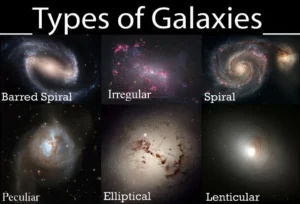
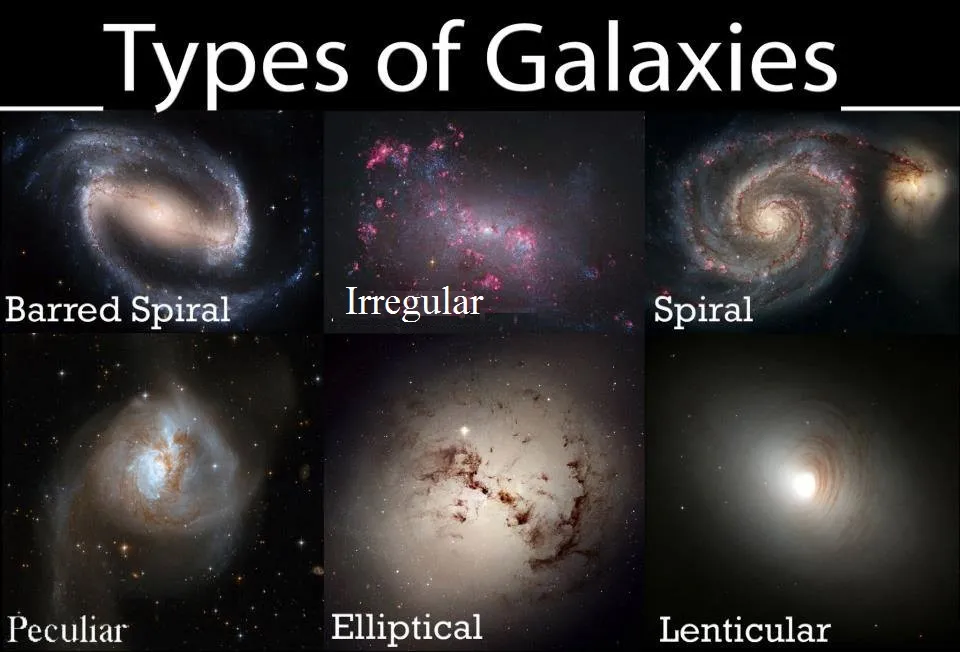
Spiral galaxies are perhaps the most recognizable, featuring a central bulge surrounded by flat, rotating disks with winding arms. These arms are rich in gas, dust, and young blue stars, where new star formation thrives due to density waves compressing interstellar material. The Milky Way and Andromeda are classic examples, each spanning about 100,000 light-years.
Classified by tightness of arms Sa for tight, Sc for loose spirals make up about 60% of observed galaxies. Their rotation, governed by dark matter, prevents collapse, and they often host supermassive black holes at their cores. Observations from the Hubble Space Telescope show how spirals evolve through mergers, sometimes transforming into other types.
Barred Spiral Galaxies: A Twist on the Classic
Similar to spirals but with a central bar of stars crossing the bulge, barred spirals like our Milky Way (classified as SBb) channel gas inward, fueling starbursts. The bar, formed by gravitational instabilities, affects about two-thirds of spirals. NGC 1300 is a stunning example, its bar stretching 3,000 light-years.
These galaxies highlight dynamic processes; simulations suggest bars form and dissolve over time, influencing galactic evolution. They are hotspots for studying how angular momentum redistributes in cosmic structures.
Elliptical Galaxies: Smooth and Spherical Giants
Elliptical galaxies lack the dramatic arms, appearing as smooth, featureless ellipsoids ranging from nearly spherical (E0) to elongated (E7). Composed mostly of older red stars with little gas, they form through major mergers that strip away star-forming material. M87, home to a famous black hole image, is a massive elliptical with trillions of stars.
Ellipticals dominate galaxy clusters, like Virgo, due to frequent interactions. Their lack of rotation means shape is maintained by random stellar orbits. Recent studies indicate some may harbor hidden disks, challenging traditional views.
Lenticular Galaxies: The Bridge Between Types
Lenticulars (S0) combine a spiral’s disk with an elliptical’s bulge but without prominent arms. They have used up or lost their gas, halting star formation. NGC 3115, the Spindle Galaxy, exemplifies this, with a flat disk and large bulge.
Often found in dense environments, lenticulars evolve from spirals via ram-pressure stripping, where hot intergalactic gas removes cold gas. They offer insights into transitional phases in galaxy life cycles.
Irregular Galaxies: Chaotic and Unpredictable
Irregular galaxies defy neat classification, lacking symmetry due to gravitational disruptions or internal bursts. The Magellanic Clouds, satellites of the Milky Way, are irregulars teeming with young stars. Types include Irr-I (some structure) and Irr-II (highly distorted).
These make up 20-25% of galaxies, often resulting from collisions. The Antennae Galaxies show merging irregulars birthing stars. They are crucial for understanding early universe conditions, as many distant galaxies appear irregular.
Peculiar and Dwarf Galaxies: The Outliers
Peculiar galaxies, like ring or interacting ones, result from unique events. Hoag’s Object features a ring around a core. Dwarfs, smaller with fewer stars, include ultra-diffuse types barely visible. The Large Magellanic Cloud is a dwarf irregular.
Dwarfs dominate numerically, aiding dark matter studies. Peculiars reveal merger dynamics, with simulations predicting future forms.
The Role of Classification in Astronomy
Edwin Hubble’s tuning fork diagram classifies galaxies, aiding evolution studies. Modern tools like JWST refine this, revealing ancient types. Galaxy types influence habitability; spirals like ours provide stable environments for life.