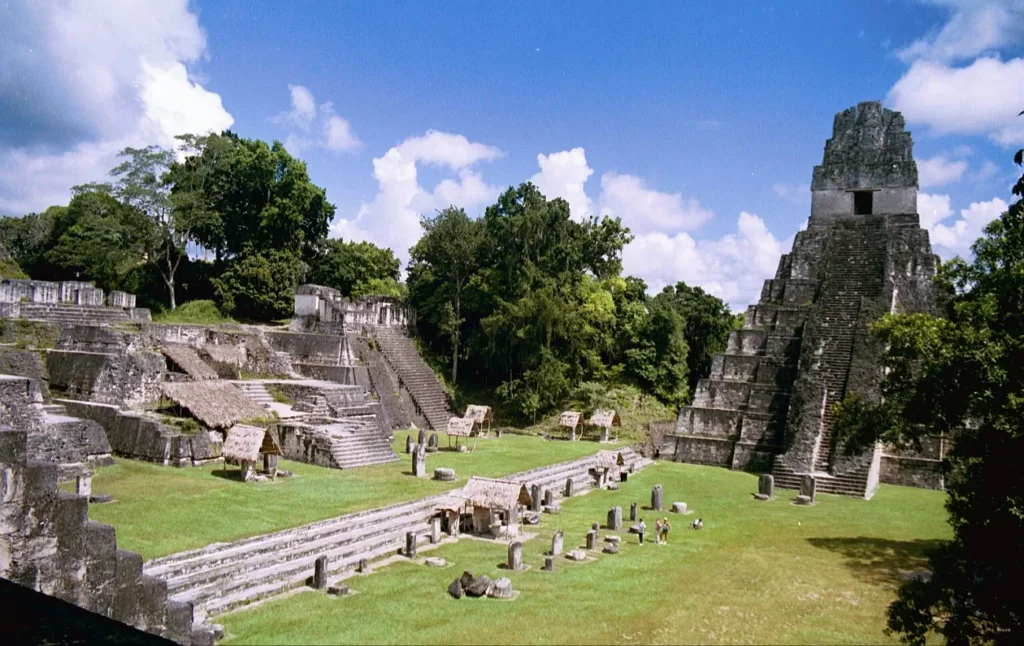
Guatemala, often called the “Heart of the Maya World,” is a land where ancient civilizations, colonial grandeur, and modern struggles intertwine. Home to towering volcanoes, lush rainforests, and vibrant indigenous cultures, its history spans from prehistoric settlements to contemporary challenges. This comprehensive overview traces Guatemala’s journey, revealing how its past continues to shape its identity as a cultural powerhouse in Central America.
Ancient Maya Civilization: Cradle of Innovation
Guatemala’s history begins with the Maya, whose sophisticated society flourished from around 2000 BCE. The Pre-Classic period (2000 BCE–250 CE) saw the rise of early cities, while the Classic period (250–900 CE) marked the zenith with monumental architecture, advanced writing, mathematics, and astronomy. Sites like Tikal, a UNESCO World Heritage site, featured towering pyramids and intricate carvings that reflected a complex society ruled by divine kings.
Tikal’s decline around 900 CE, possibly due to drought, warfare, or resource depletion, led to the Post-Classic period (900–1500 CE), where smaller kingdoms persisted. The Maya developed hieroglyphic writing, a precise calendar, and extensive trade networks, leaving an enduring legacy in art, religion, and knowledge that influences Guatemala today.
Spanish Conquest and Colonial Rule
European contact arrived with Christopher Columbus in 1502, but conquest began in 1523–1524 when Pedro de Alvarado defeated Maya forces, establishing Spanish rule. By 1540, Guatemala became the Captaincy General of Guatemala, encompassing much of Central America, with Santiago de los Caballeros (now Antigua Guatemala) as capital.
Colonial society was hierarchical: Spanish elites controlled land and labor through encomiendas and repartimientos, exploiting indigenous populations. The Catholic Church played a central role, converting natives while building magnificent churches. Earthquakes devastated Antigua in 1773, prompting the capital’s move to Guatemala City.
Path to Independence and 19th-Century Turmoil
Guatemala declared independence from Spain on September 15, 1821, briefly joining Mexico before becoming part of the Federal Republic of Central America in 1823. Internal divisions between liberals (favoring reform) and conservatives (defending tradition) led to the federation’s collapse by 1841. Rafael Carrera, a conservative caudillo, dominated from 1838–1865, restoring Church power and stabilizing the country.
Liberal reforms under Justo Rufino Barrios (1871–1885) modernized infrastructure, promoted coffee exports, and secularized education, but often at the expense of indigenous lands.
20th-Century Dictatorships and the Ten Years of Spring
The early 20th century saw authoritarian rule, including Jorge Ubico’s dictatorship (1931–1944), which modernized but repressed dissent. A 1944 revolution ushered in democratic reforms under Juan José Arévalo and Jacobo Árbenz, including land redistribution to benefit peasants.
In 1954, a CIA-backed coup overthrew Árbenz, fearing communist influence amid Cold War tensions, halting reforms and sparking decades of instability.
Civil War and Its Devastating Legacy
From the 1960s, guerrilla movements clashed with military governments in a brutal civil war (1960–1996). Over 200,000 people died or disappeared, many in massacres targeting indigenous Maya communities. The 1980s under Efraín Ríos Montt saw intense repression, labeled genocide by later inquiries.
Peace accords in 1996 ended the conflict, leading to truth commissions and gradual democratization.
Modern Guatemala: Challenges and Resilience
Today, Guatemala grapples with inequality, corruption, migration, and natural disasters like hurricanes. Yet, its Maya heritage thrives through festivals, languages, and sites like Tikal. Tourism, agriculture, and remittances drive the economy, while indigenous movements advocate for rights.
Guatemala’s history from ancient pyramids to hard-won peace embodies resilience and cultural depth, inviting exploration of its timeless wonders.
(Word count: 802)