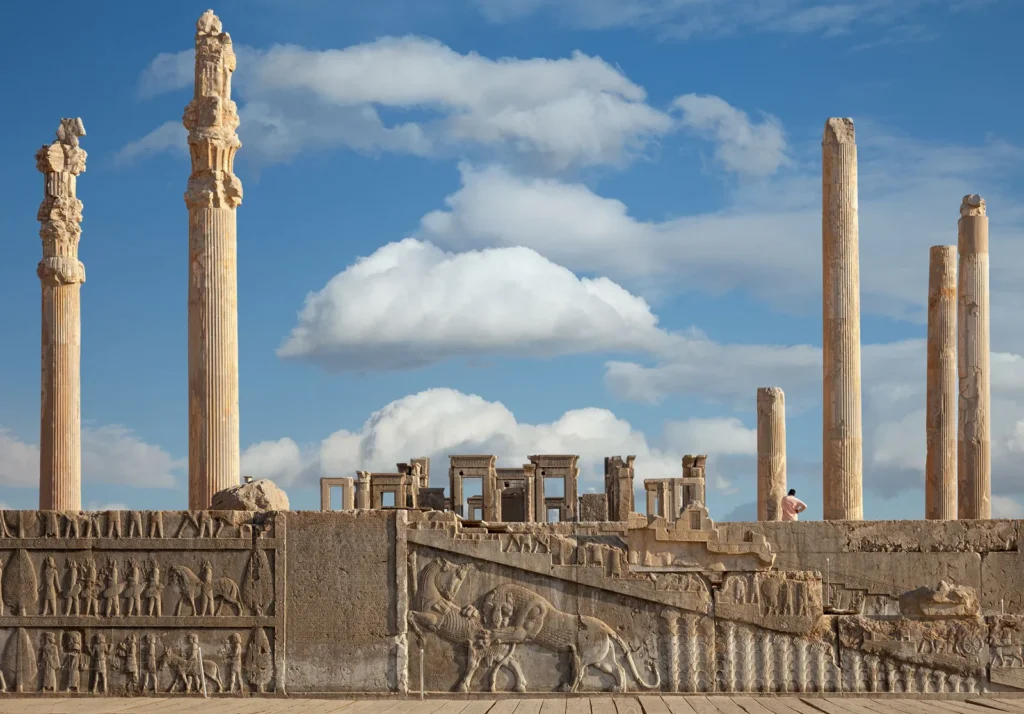
Iran, once the heart of mighty empires like the Achaemenid and Sassanid, boasts one of the world’s oldest continuous civilizations. From ancient Zoroastrian roots to the Islamic Republic, its history is marked by conquests, cultural golden ages, and resilient identity. Rich in poetry, architecture, and innovation, Iran continues to captivate with sites like Persepolis and modern Tehran.
Ancient Empires: Achaemenid Glory
Human settlement in Iran dates back to 7000 BCE, with early civilizations in Elam. The Achaemenid Empire, founded by Cyrus the Great in 550 BCE, became the largest ancient empire, stretching from India to Egypt. Cyrus’s Cylinder is an early human rights charter. Darius I built Persepolis as a ceremonial capital, showcasing grand architecture and multicultural tolerance.
Alexander the Great conquered in 330 BCE, but Parthian (247 BCE–224 CE) and Sassanid (224–651 CE) empires revived Persian power. Zoroastrianism flourished, influencing art and governance.
Islamic Conquest and Golden Age
Arab Muslims conquered in 651 CE, introducing Islam. The Abbasid Caliphate (750–1258) saw Persian culture thrive in Baghdad. Scholars like Avicenna advanced medicine and philosophy.
The Seljuk Turks (11th century) and Mongols (13th century) invaded, but the Safavid Empire (1501–1736) established Shia Islam as state religion, creating iconic architecture like Isfahan’s mosques.
Qajar and Pahlavi Dynasties
Qajar rule (1794–1925) faced European influence and territorial losses. Reza Shah Pahlavi modernized in 1925, building infrastructure but enforcing secularism. His son Mohammad Reza Shah pursued Westernization and oil wealth, leading to the White Revolution.
Islamic Revolution and Modern Era
The 1979 Revolution overthrew the monarchy, establishing an Islamic Republic under Ayatollah Khomeini. The Iran-Iraq War (1980–1988) caused massive losses. Today, Iran navigates sanctions, nuclear issues, and cultural preservation.
Iran’s history from ancient tolerance to revolutionary zeal shapes its enduring legacy.