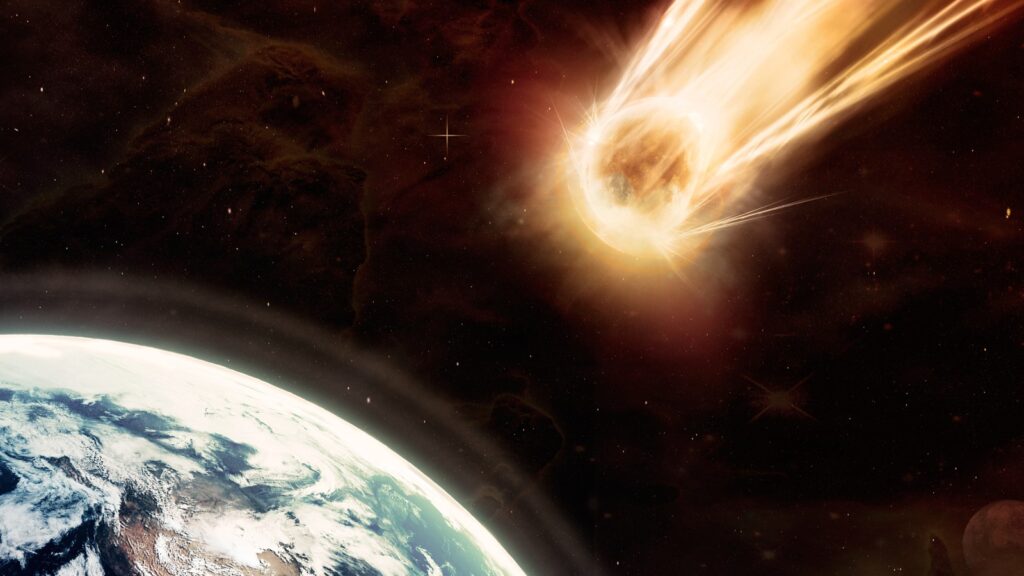
The solar system is filled with rocky objects of many sizes. Some remain in space as asteroids, while others streak through Earth’s atmosphere or fall to the ground as meteorites. Understanding the differences helps scientists study planetary formation and impact risks.
What Is an Asteroid
Asteroids are rocky bodies that orbit the Sun, mostly concentrated in the main belt between Mars and Jupiter. Sizes range from massive objects hundreds of kilometers wide to much smaller fragments.
Asteroids are considered remnants from the early solar system and provide clues about how planets formed.
Asteroid Populations
Besides the main belt, asteroids can be found in other groups:
- Trojan asteroids that share Jupiter’s orbit
- Near Earth asteroids whose paths come close to our planet
These near Earth objects are closely monitored because of potential impact hazards.
What Is a Meteoroid
A meteoroid is a much smaller rocky or metallic object in space. It can be no bigger than a grain of sand or up to about a meter across.
Most meteoroids originate from asteroid collisions or debris shed by comets.
Meteors in the Atmosphere
When a meteoroid enters Earth’s atmosphere, it heats up rapidly due to compression and friction with air molecules. This produces a bright streak of light called a meteor, often referred to as a shooting star.
Many meteors vaporize completely before reaching the ground.
Meteor Showers
Meteor showers occur when Earth passes through a stream of debris left behind by a comet. During these events, dozens of meteors may appear each hour.
What Is a Meteorite
If part of a meteoroid survives its fiery descent and lands on Earth, it becomes a meteorite.
Meteorites are classified into three major types:
- Stony meteorites
- Iron meteorites
- Stony iron meteorites
These samples are extremely valuable to scientists because they preserve material older than Earth itself.
Why These Objects Matter
Studying asteroids and meteorites helps researchers learn about the early solar system, chemical evolution, and possible threats from future impacts. Space agencies also investigate whether some asteroids could be used for resource mining in the future.
Famous Examples
Ceres is the largest object in the asteroid belt and is also classified as a dwarf planet. The Tunguska explosion in Siberia is believed to have been caused by an incoming space object that disintegrated in the atmosphere.
From massive asteroids to tiny meteoroids, these objects show how dynamic and active our solar system remains. Their fiery encounters with Earth connect us directly to cosmic history.