Black holes, the enigmatic voids where gravity reigns supreme, captivate scientists and the public alike. These cosmic phenomena, where not even light can escape, form through stellar collapses, mergers, and possibly primordial processes, challenging our understanding of physics. From stellar-mass black holes born in supernova remnants to supermassive giants at galactic centers, their formation reveals the universe’s extreme conditions.
This article delves into the mechanics of black hole formation, exploring types, processes, and implications. Optimized for queries like “how do black holes form” or “black hole origins explained,” it provides an informative overview backed by astronomical evidence. Whether you’re an astronomy enthusiast or seeking SEO-rich content on cosmic mysteries, discover how these “holes” in space-time emerge and evolve.
Defining Black Holes – Gravity’s Ultimate Trap
A black hole is a region where gravity is so intense that nothing, including light, can escape beyond the event horizon the point of no return. At its core lies a singularity, a point of infinite density where laws of physics break down.
Black holes aren’t “holes” but dense matter concentrations. They warp space-time, bending light and time itself.
Also See : Black Holes Demystified, Understanding Their Formation and Cosmic Mysteries.
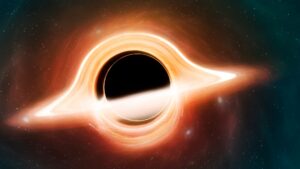
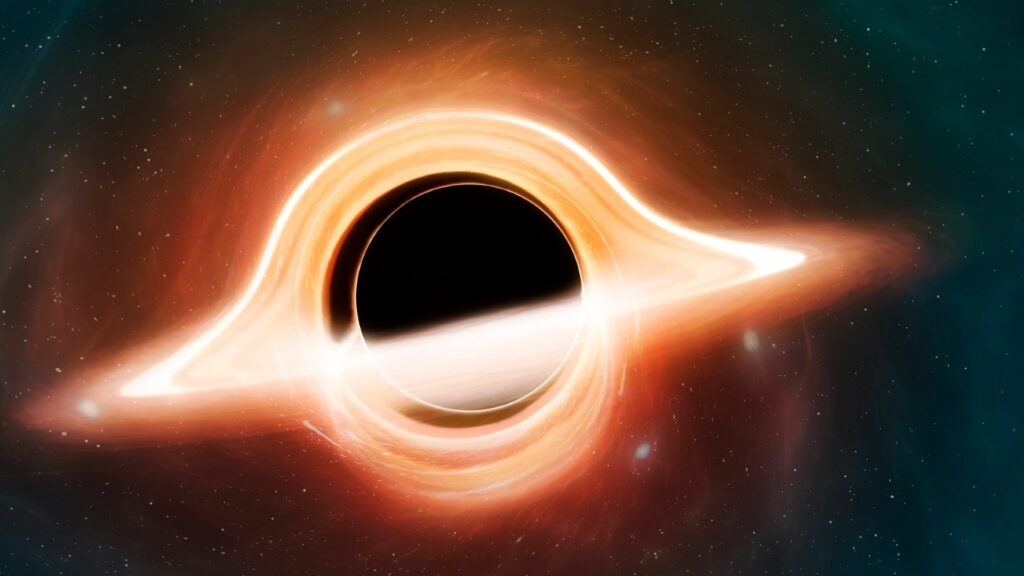
This illustration shows the accretion disk and warped light around a black hole.
Stellar-Mass Black Holes – Born from Dying Stars
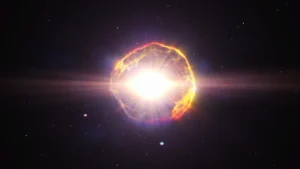
Most known black holes form from massive stars (at least 20 solar masses) collapsing at life’s end. When fuel runs out, the core can’t resist gravity, imploding while outer layers explode as a supernova.
If the core exceeds about three solar masses, it forms a black hole instead of a neutron star. Examples include Cygnus X-1, detected via X-ray emissions from accreted gas.
This process ejects material, leaving a black hole of 5-10 solar masses.
Supermassive Black Holes – Giants at Galactic Hearts
Supermassive black holes, millions to billions of solar masses, reside in most galaxy centers, like Sagittarius A* in the Milky Way. Their formation is debated: possibly from direct collapse of massive gas clouds in the early universe or mergers of smaller black holes.
Mergers occur when galaxies collide, combining black holes and emitting gravitational waves, as detected by LIGO.
Primordial Black Holes – Relics from the Big Bang?
Hypothetical primordial black holes may have formed seconds after the Big Bang from density fluctuations. These could range from microscopic to massive, potentially explaining dark matter.
Though unconfirmed, future observations might detect them via Hawking radiation or microlensing.
Growth Through Accretion and Mergers
Once formed, black holes grow by accreting matter from accretion disks, heating gas to emit X-rays. In binary systems, they siphon material from companion stars.
Mergers amplify growth, especially for supermassives during galaxy interactions.
Detecting Black Holes – Invisible Yet Observable
Black holes are detected indirectly: through gravitational effects on stars, X-ray binaries, or gravitational waves. The Event Horizon Telescope imaged M87*’s shadow in 2019.
Quasars, powered by accreting supermassives, illuminate early universe formation.
Implications – Black Holes in Cosmic Evolution
Black holes influence galaxy formation, regulating star birth via feedback. They may link to dark energy theories.
Future missions like LISA will detect more mergers, refining formation models.