Italy, the boot-shaped peninsula in the heart of the Mediterranean, has profoundly shaped Western civilization for over two millennia. From the rise of the Roman Empire to the Renaissance’s artistic explosion, fascist rule, and its modern status as a cultural and economic powerhouse, Italy’s history is a captivating blend of glory, turmoil, innovation, and resilience. This detailed journey explores the key eras that transformed a collection of city-states into a unified nation renowned for art, cuisine, fashion, and heritage.
Ancient Origins: Etruscans, Greeks, and the Founding of Rome
Human presence in Italy dates back to the Paleolithic era, but significant cultural development began with the Etruscans around 900 BCE in central Italy. This sophisticated civilization built advanced cities, mastered metalworking, and influenced early Roman society with engineering, urban planning, and religious practices.
In the south, Greek colonists established Magna Graecia from the 8th century BCE, founding cities like Syracuse and Tarentum that brought philosophy, theater, and democracy. Meanwhile, on the Tiber River, legend holds that Romulus founded Rome in 753 BCE after the famous tale of Romulus and Remus raised by a she-wolf.
Rome evolved from a monarchy to a republic in 509 BCE, establishing a system of checks and balances with the Senate, consuls, and assemblies. Early expansion subdued neighboring tribes, including the Samnites and Etruscans, setting the stage for Mediterranean dominance.
The Roman Republic and Empire: From Republic to Eternal City
The Republic’s conquests accelerated after defeating Carthage in the Punic Wars (264–146 BCE), making Rome master of the western Mediterranean. Internal strife followed: the Gracchi brothers’ land reforms, Marius and Sulla’s civil wars, and the rise of powerful generals like Pompey and Julius Caesar.
Caesar’s crossing of the Rubicon in 49 BCE sparked civil war, ending with his assassination in 44 BCE. His adopted heir, Octavian (later Augustus), defeated Mark Antony and Cleopatra at Actium in 31 BCE, ushering in the Principate and the Roman Empire in 27 BCE.
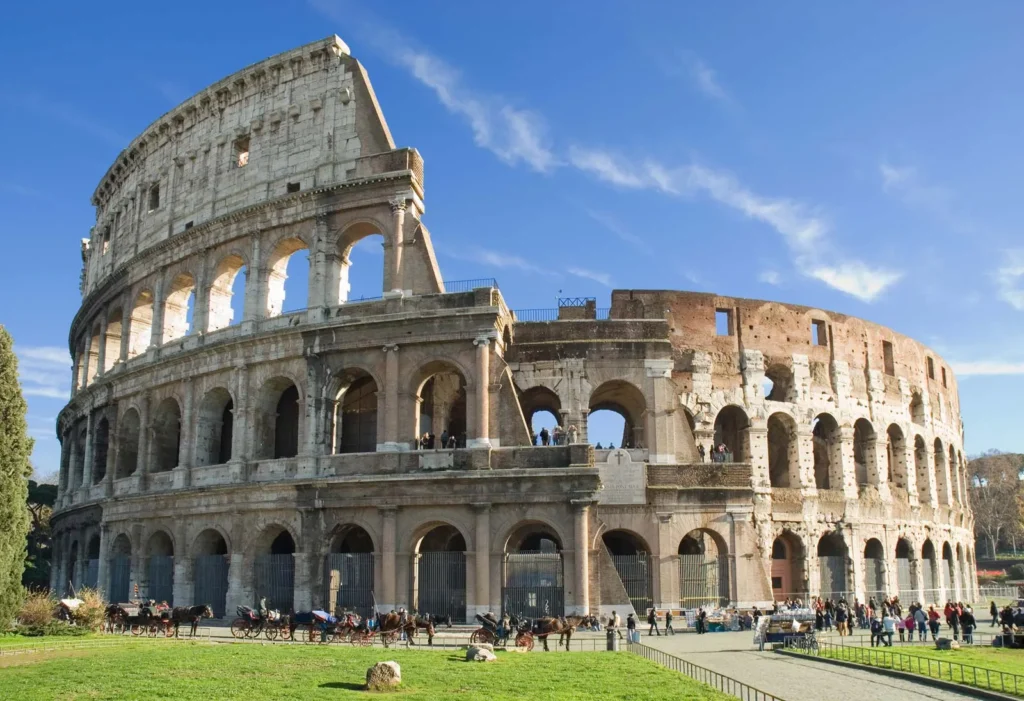
The Pax Romana (27 BCE–180 CE) brought unprecedented peace, prosperity, and infrastructure—roads, aqueducts, and monumental architecture like the Colosseum (completed 80 CE) and Pantheon. Emperors from Trajan to Hadrian expanded borders to Britain and Mesopotamia. Christianity emerged in the 1st century CE and became the state religion under Constantine in 313 CE (Edict of Milan).
The Western Empire collapsed in 476 CE when Odoacer deposed Romulus Augustulus, while the Eastern (Byzantine) Empire endured.
Medieval Italy: Fragmentation, City-States, and Papal Power
After Rome’s fall, Italy fragmented into Lombard kingdoms, Byzantine territories, and papal lands. Charlemagne crowned Holy Roman Emperor in 800 CE in Rome, but real power lay with local lords and emerging communes.
By the 11th–12th centuries, northern city-states like Venice, Genoa, Florence, and Milan grew wealthy through trade and banking. Venice became a maritime superpower controlling Mediterranean commerce, while Florence’s wool and banking industries (Medici family) fueled cultural revival.
The Papal States, centered in Rome, wielded spiritual and temporal power, often clashing with the Holy Roman Empire in the Investiture Controversy and Guelph-Ghibelline wars.
The Renaissance: Birthplace of Modernity
The Renaissance (14th–17th centuries) began in Italy, reviving classical learning and humanism. Florence led under Medici patronage, producing giants like Leonardo da Vinci, Michelangelo, and Raphael. Brunelleschi’s dome on Florence Cathedral (1436) symbolized engineering brilliance, while Machiavelli’s The Prince offered pragmatic political theory.
Venice’s Bellini family and Titian advanced painting, and Rome’s Sistine Chapel ceiling (1508–1512) by Michelangelo became an icon of human achievement. The period also saw scientific progress (Galileo) and exploration (Columbus, Vespucci).
Foreign Domination and the Risorgimento
After the Renaissance, Italy suffered foreign invasions—French, Spanish, and Austrian. The 1494–1559 Italian Wars devastated the peninsula, leading to Spanish Habsburg dominance in the south and Milan, while Venice and the Papal States retained independence.
The 18th–19th centuries brought Enlightenment ideas and Napoleonic occupation (1796–1814), which introduced modern administration and sparked nationalism. After Napoleon’s fall, the Congress of Vienna (1815) restored old regimes, but secret societies like Carbonari and Young Italy (founded by Mazzini) pushed for unification.
The Risorgimento culminated under Count Cavour (Piedmont-Sardinia) and Giuseppe Garibaldi’s Expedition of the Thousand (1860). Victor Emmanuel II was proclaimed King of Italy in 1861, with Rome joining in 1870 after French withdrawal.
Fascism, World War II, and the Republic
Italy industrialized rapidly but faced social unrest. Benito Mussolini founded fascism in 1919, seizing power in the 1922 March on Rome. His regime pursued aggressive imperialism (Ethiopia 1935, Albania 1939) and allied with Nazi Germany.
World War II brought disaster: defeats in Africa and Greece, Allied invasion (1943), and Mussolini’s execution (1945). Civil war between partisans and fascists claimed tens of thousands of lives.
A 1946 referendum abolished the monarchy; the Republic was born with a democratic constitution (1948). The post-war “economic miracle” (1950s–1960s) transformed Italy into an industrial power with Fiat, fashion, and design.
Contemporary Italy: Challenges and Cultural Powerhouse
Italy joined the EU founding members (1957) and adopted the euro (1999). It faces regional disparities (north vs. south), political instability (over 60 governments since 1948), corruption scandals, and migration pressures.
Yet Italy remains a global leader in tourism (Rome, Venice, Florence), cuisine (pizza, pasta, gelato), luxury brands (Gucci, Ferrari), and UNESCO sites (59 as of 2025). Its soft power endures through cinema (Fellini, Sorrentino), opera, and timeless landmarks.
Italy’s Enduring Influence
Italy’s history is a continuous thread of creativity and reinvention from Roman law and engineering to Renaissance humanism and modern design. Despite periods of division and hardship, the peninsula has repeatedly given the world ideas, art, and beauty that transcend borders. Visiting the Colosseum, strolling Florence’s streets, or sailing the Amalfi Coast means walking through layers of this extraordinary past.