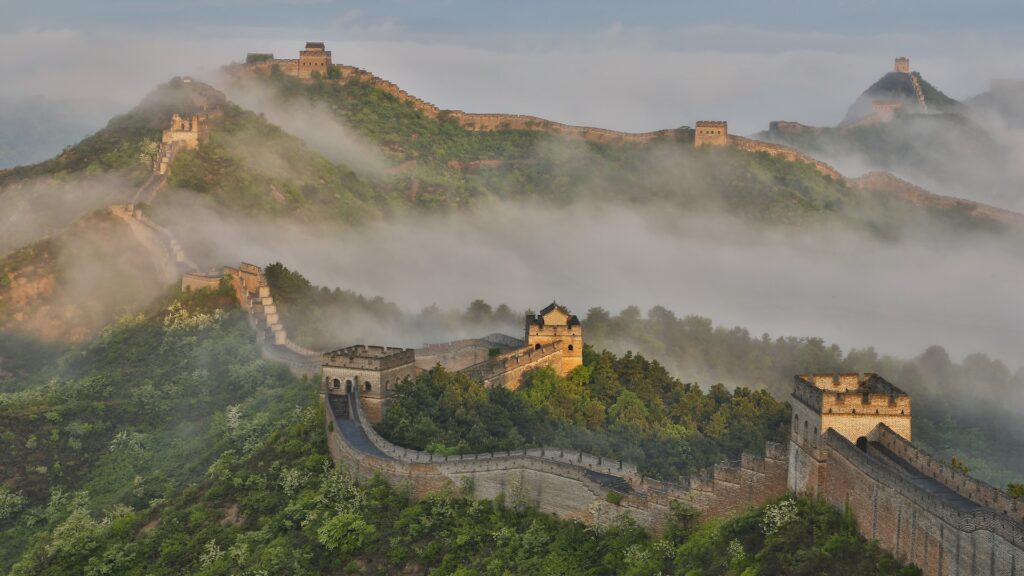
Origins of Chinese Civilization
China is one of the world’s oldest continuous civilizations. Early societies developed along the Yellow and Yangtze Rivers, forming agricultural communities and early states.

Dynastic Rule and Imperial Power
The Qin Dynasty unified China in 221 BCE, standardizing laws, writing, and currency. Subsequent dynasties such as Han, Tang, and Song advanced science, philosophy, and trade.
Confucianism and Governance
Confucian philosophy shaped Chinese governance, emphasizing hierarchy, education, and moral leadership for over two millennia.
Mongol and Manchu Rule
Foreign dynasties such as the Yuan and Qing ruled China, expanding its borders and connecting it to global trade networks.
Decline of Imperial China
In the 19th century, internal rebellion and foreign intervention weakened the Qing Dynasty. China became vulnerable to imperial powers.
Republican Era and Civil War
The Qing Dynasty fell in 1911, leading to the Republic of China. Political fragmentation and civil war followed.
Establishment of the People’s Republic
In 1949, the Communist Party established the People’s Republic of China under Mao Zedong, transforming society through socialist reforms.
Reform and Global Rise
Since the late 20th century, economic reforms turned China into a global manufacturing and technological powerhouse.
Modern China
Today, China plays a central role in global politics, economics, and culture while drawing from its deep historical roots.