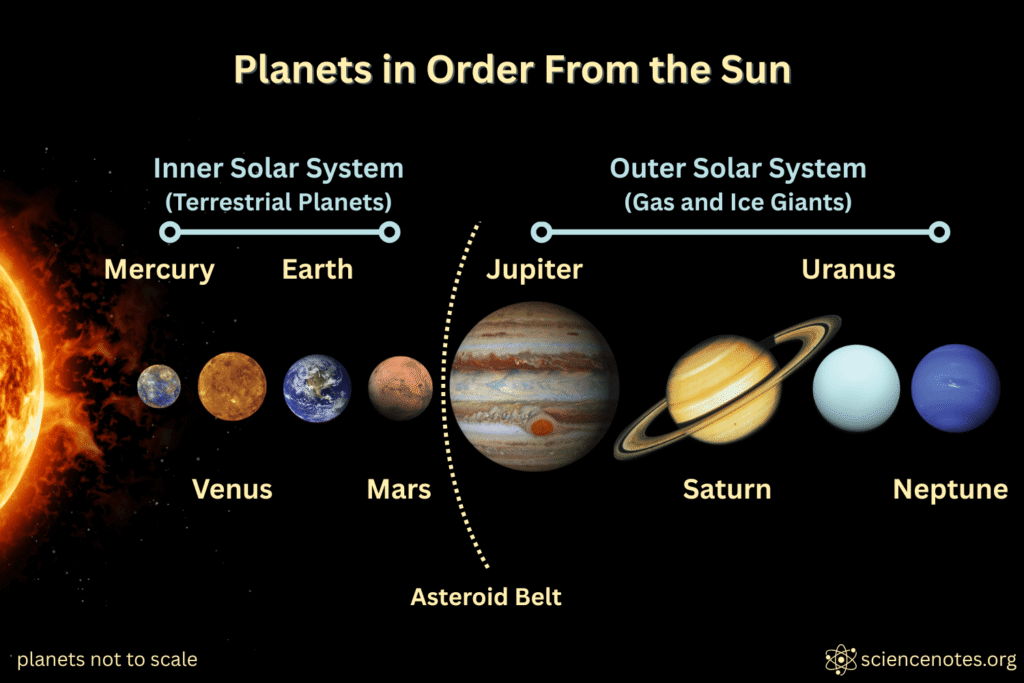
Our solar system consists of eight official planets orbiting the Sun, arranged in order of increasing distance. This order—from closest to farthest is: Mercury, Venus, Earth, Mars, Jupiter, Saturn, Uranus, and Neptune. These planets are divided into inner (terrestrial) and outer (gas/ice giants) groups, separated by the asteroid belt.
Visual diagrams clearly show this sequence and relative distances.
Detailed List of Planets in Order
Here’s a comprehensive overview with key facts, including average distance from the Sun (in Astronomical Units, where 1 AU ≈ 149.6 million km), orbital period, and notable features:
| Order | Planet | Type | Average Distance (AU) | Orbital Period (Earth Years) | Key Features |
|---|---|---|---|---|---|
| 1 | Mercury | Terrestrial | 0.39 | 0.24 (88 days) | Smallest planet, no atmosphere, extreme temperatures |
| 2 | Venus | Terrestrial | 0.72 | 0.62 (225 days) | Hottest planet, thick CO₂ atmosphere, retrograde rotation |
| 3 | Earth | Terrestrial | 1.00 | 1 | Only known planet with life, water oceans |
| 4 | Mars | Terrestrial | 1.52 | 1.88 | Red planet, polar ice caps, largest volcano (Olympus Mons) |
| 5 | Jupiter | Gas Giant | 5.20 | 11.86 | Largest planet, Great Red Spot storm, 95+ moons |
| 6 | Saturn | Gas Giant | 9.54 | 29.46 | Iconic rings, least dense planet, 146+ moons |
| 7 | Uranus | Ice Giant | 19.2 | 84.01 | Tilted on its side, faint rings, 27 moons |
| 8 | Neptune | Ice Giant | 30.06 | 164.8 | Strongest winds, deep blue color, 14 moons |
Individual Planet Highlights
- Mercury – The swiftest planet, closest to the Sun.
- Venus – Earth’s “twin” in size but with a runaway greenhouse effect.
- Earth – Our home, the blue marble.
- Mars – The red planet, target for future human exploration.
- Jupiter – King of the planets with its massive storms.
- Saturn – Famous for its stunning ring system.
- Uranus – The sideways-rotating ice giant.
- Neptune – The windiest planet in the outer reaches.
Note on Pluto
Pluto, once considered the ninth planet, is now classified as a dwarf planet by the International Astronomical Union (2006). It resides in the Kuiper Belt with an average distance of 39.5 AU.
All data is based on NASA and IAU standards. The solar system’s structure continues to fascinate astronomers worldwide!