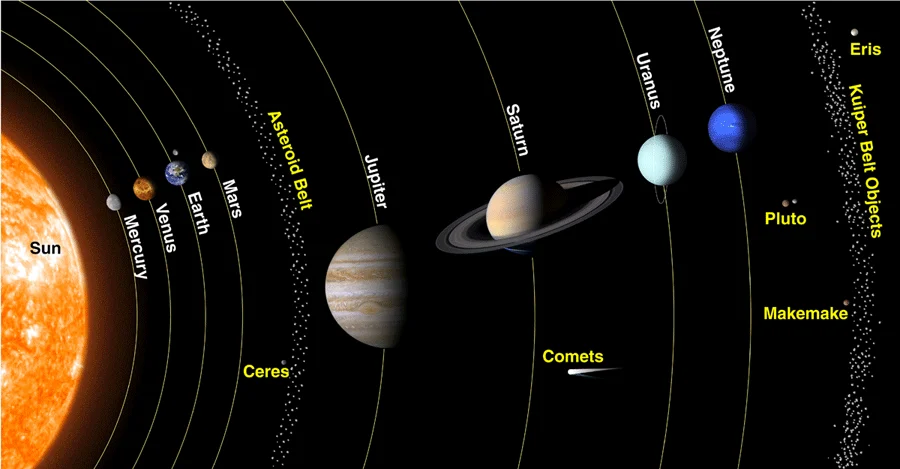
The asteroid belt, a vast region of rocky remnants between Mars and Jupiter, holds keys to planetary formation. This doughnut-shaped zone, home to millions of asteroids, fascinates astronomers and fuels space exploration ambitions.
Formation and Location: Between Inner and Outer Planets
Located 2.1 to 3.3 astronomical units (AU) from the Sun about 329 to 493 million kilometers the main asteroid belt separates terrestrial planets (Mercury, Venus, Earth, Mars) from gas giants (Jupiter, Saturn, Uranus, Neptune). Jupiter’s gravity prevented these remnants from coalescing into a planet during solar system formation.
The belt spans 140 million kilometers wide but is sparse; asteroids are separated by vast distances, making collisions rare. Total mass is about 4% of the Moon’s, mostly in larger bodies like Ceres (940 km diameter), now a dwarf planet.
Types of Asteroids: Composition and Classification
Asteroids are classified by spectra: C-type (carbonaceous, dark, primitive), S-type (silicaceous, stony), and M-type (metallic, iron-nickel). C-types dominate the outer belt, S-types the inner.
Notable ones include Vesta (525 km), with a basaltic crust from ancient volcanism, and Pallas (512 km), tilted oddly. Trojans share Jupiter’s orbit; Hildas resonate with it. Near-Earth asteroids (NEAs) cross our path, posing risks.
Exploration Missions: Probing the Belt’s Secrets
NASA’s Dawn mission (2007-2018) orbited Vesta and Ceres, revealing water ice and organic molecules on Ceres, suggesting habitability potential. Japan’s Hayabusa2 sampled Ryugu, returning material in 2020 showing hydrated minerals.
OSIRIS-REx collected from Bennu, returning in 2023 with carbon-rich samples hinting at life’s origins. Future missions like Psyche (launching 2023) target metallic asteroids for core insights.
Asteroids’ Role in Solar System Dynamics
Jupiter’s resonances create Kirkwood gaps, empty zones in the belt. Perturbations eject asteroids, some becoming NEAs or meteors. The belt’s debris contributed to Earth’s heavy bombardment, delivering water and organics.
Mining potential attracts companies like Planetary Resources, eyeing platinum and water for space fuel. Legal frameworks like the Artemis Accords address resource use.
Observing the Asteroid Belt: From Earth and Beyond
Amateurs spot bright asteroids like Vesta with telescopes. Apps track positions. Hubble and James Webb provide detailed images, while ground-based surveys like Pan-STARRS catalog threats.
The belt’s study evolves with technology, from Galileo’s 1801 Ceres discovery to modern spectroscopy revealing compositions.
Challenges and Future Prospects
Collision risks in the belt are low for spacecraft, as demonstrated by probes passing through. However, NEAs require monitoring via NASA’s Sentry system.
As we eye asteroid mining and deflection, the belt represents untapped resources and scientific treasure. International collaboration will unlock its mysteries.