Comets, often called “dirty snowballs” of the cosmos, captivate skywatchers with their luminous tails streaking across the night sky. These icy bodies from the solar system’s fringes offer insights into our origins and the universe’s dynamics. Understanding comets and their stunning light tails not only fuels astronomical interest but also enhances stargazing experiences, making them a prime topic for space enthusiasts.
What Are Comets? Origins and Composition
Comets are remnants from the solar system’s formation about 4.6 billion years ago, primarily residing in the Oort Cloud or Kuiper Belt. Composed of ice, dust, rock, and organic compounds, they range from a few kilometers to tens of kilometers in diameter. When a comet approaches the Sun, solar heat causes sublimation ice turning directly to gas forming a coma, a hazy envelope around the nucleus.
This process releases dust and gas, creating the iconic tail. Famous comets like Halley’s Comet, visible every 76 years, consist of water ice, carbon dioxide, methane, and ammonia. Space missions like Rosetta’s 2014 landing on Comet 67P/Churyumov-Gerasimenko revealed complex organics, hinting at comets’ role in delivering water and life-building blocks to Earth.
The Magic of Comet Tails: Formation and Types
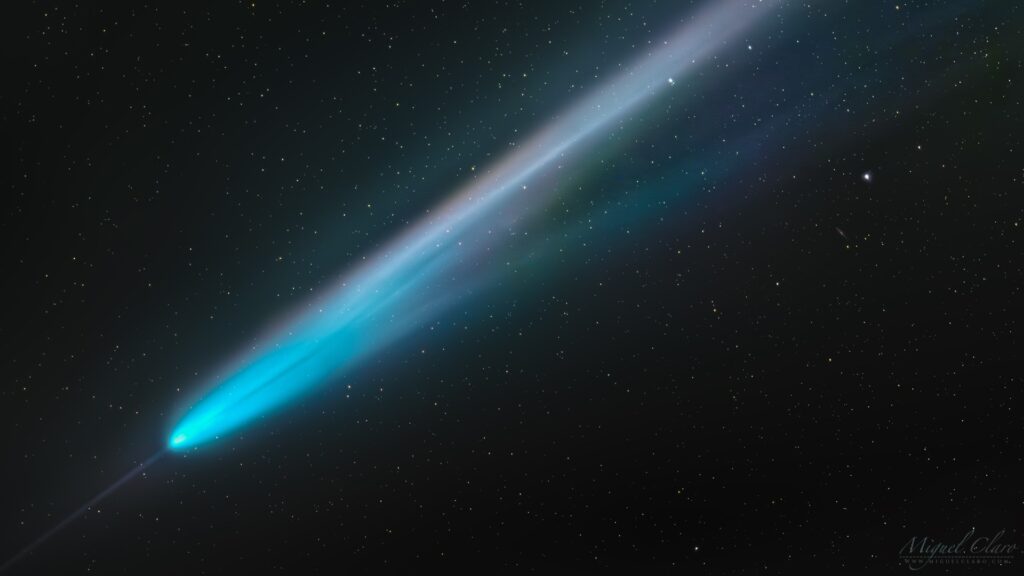
A comet’s tail forms as it nears the Sun, with radiation and solar wind pushing material away. There are two main types: the dust tail, curved and yellowish from reflected sunlight, and the ion tail, straight and bluish from ionized gases interacting with solar wind. Tails can stretch millions of kilometers, always pointing away from the Sun.
In rare cases, like Comet McNaught in 2007, tails become extraordinarily bright, visible even in daylight. The tail’s length and brightness depend on the comet’s size, composition, and proximity to the Sun perihelion. Anti-tails, appearing to point toward the Sun, are optical illusions from dust in the orbital plane.
Famous Comets Throughout History
Humanity has observed comets for millennia, often interpreting them as omens. The Bayeux Tapestry depicts Halley’s Comet during the 1066 Battle of Hastings. Comet Hale-Bopp in 1997, with its dual tails spanning 50 degrees, was visible for 18 months, inspiring awe and, sadly, misconceptions.
More recently, Comet NEOWISE in 2020 dazzled with a curved dust tail and straight ion tail, photographed globally. These events highlight comets’ unpredictability some disintegrate near the Sun, like sungrazers from the Kreutz family.
Observing Comets: Tips for Skywatchers
To spot comets, check astronomy apps for predictions. Use binoculars or telescopes in dark skies, away from city lights. Peak visibility occurs when comets are closest to Earth or the Sun. Organizations like the International Comet Quarterly track appearances.
Amateur astronomers contribute by reporting discoveries, as with Comet Tsuchinshan-ATLAS in 2023. Safety is key—never look directly at the Sun when observing perihelion comets.
Scientific Significance and Future Missions
Comets provide clues to solar system evolution. NASA’s Stardust mission returned samples from Comet Wild 2, revealing glycine, an amino acid. Upcoming endeavors like the European Space Agency’s Comet Interceptor aim to study pristine comets.
Understanding tails helps model solar wind and space weather, impacting satellite operations. Comets’ role in Earth’s water supply supports theories of panspermia life seeding via cosmic bodies.