Iraq, often called the “Cradle of Civilization,” lies in the heart of ancient Mesopotamia “the land between the rivers” Tigris and Euphrates. This fertile region birthed some of humanity’s earliest innovations: writing, cities, laws, and empires. From Sumerian ziggurats to the golden age of Baghdad, Ottoman rule, British mandate, Saddam Hussein’s dictatorship, and post-2003 struggles, Iraq’s history is one of extraordinary achievements shadowed by conquests, conflicts, and resilience.
Ancient Mesopotamia: Dawn of Human Civilization
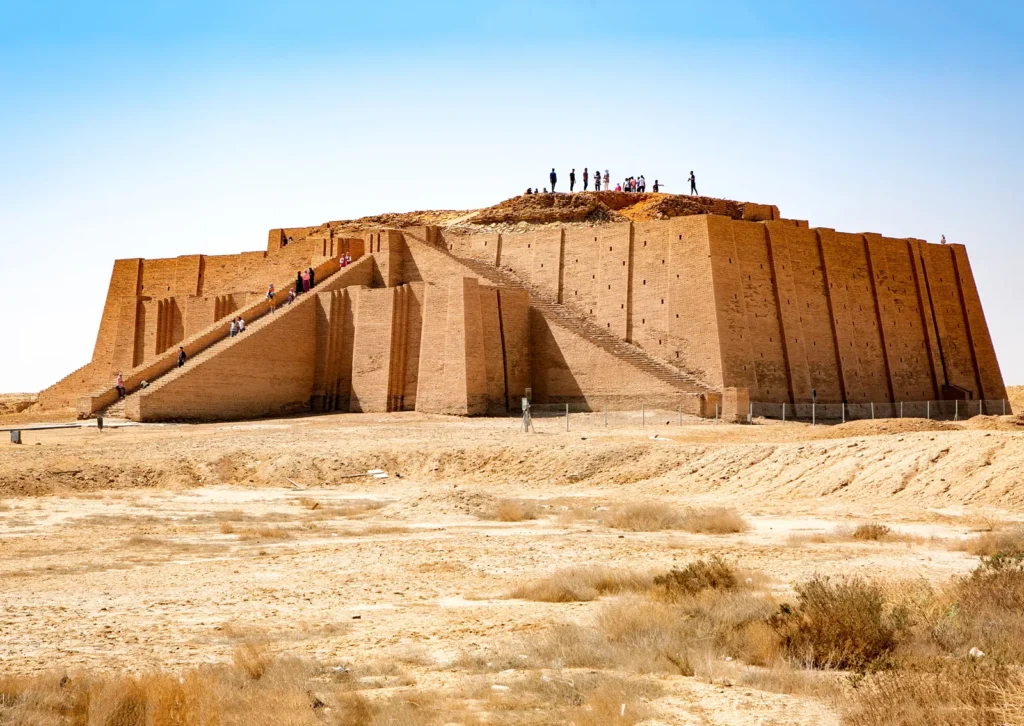
Human habitation in Iraq dates back to the Paleolithic era, but true civilization emerged around 4500–3500 BCE with the Sumerians in southern Mesopotamia. They developed the world’s first known writing system (cuneiform), built city-states like Uruk, Ur, and Eridu, and constructed massive stepped temples called ziggurats.
The Ziggurat of Ur, dedicated to the moon god Nanna, exemplifies Sumerian architectural prowess and religious devotion.
Around 2334 BCE, Sargon of Akkad unified the region into the first empire, blending Sumerian culture with Semitic elements. Successive powers followed: the Third Dynasty of Ur (Neo-Sumerian), Old Babylonian Empire under Hammurabi (c. 1792–1750 BCE) with his famous law code, and the Assyrians (Neo-Assyrian Empire, 911–609 BCE), known for military might and libraries like Nineveh’s.
The Neo-Babylonian Empire (626–539 BCE) under Nebuchadnezzar II built the Hanging Gardens and Ishtar Gate, but fell to Cyrus the Great’s Achaemenid Persians in 539 BCE.
Hellenistic, Parthian, Sassanid, and Early Islamic Periods
Alexander the Great conquered in 331 BCE, followed by Seleucid rule. Parthians (247 BCE–224 CE) and Sassanids (224–651 CE) revived Persian traditions, with Ctesiphon as a capital. Christianity spread, and Zoroastrianism dominated.
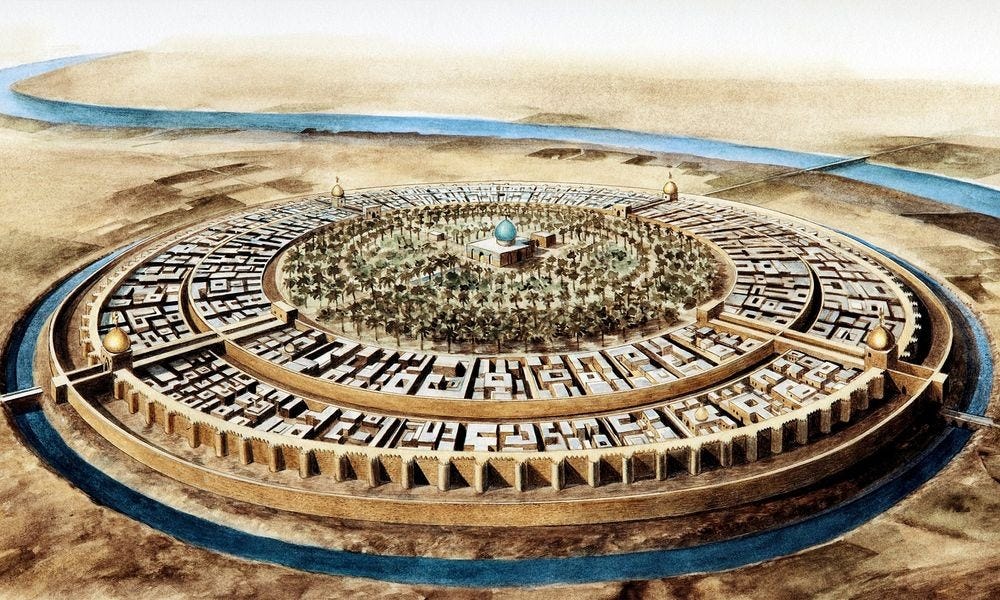
The Muslim conquest in 636–638 CE, after the Battle of al-Qadisiyyah, integrated Iraq into the Rashidun and Umayyad caliphates. The Abbasid Revolution (750 CE) shifted power eastward; Caliph al-Mansur founded Baghdad in 762 as the “City of Peace.”
The Abbasid Golden Age: Baghdad as the World’s Center
Under the Abbasids (750–1258), Baghdad became Islam’s intellectual hub. The House of Wisdom translated Greek, Persian, and Indian texts, advancing mathematics (algebra by al-Khwarizmi), medicine (Ibn Sina), astronomy, and philosophy. Scholars from diverse backgrounds thrived in a multicultural environment.
This era of prosperity ended with the Mongol sack of Baghdad in 1258 under Hulagu Khan, destroying libraries and killing hundreds of thousands, marking a devastating blow to Islamic civilization.
Ottoman Rule and Decline (1534–1918)
Ottomans conquered in 1534, incorporating Iraq into their empire as provinces (Baghdad, Basra, Mosul). Local Mamluk dynasties governed semi-autonomously in the 18th–19th centuries. Mid-19th-century Tanzimat reforms modernized administration, but corruption and tribal unrest persisted.
World War I saw British forces capture Baghdad (1917). The Ottoman defeat led to the League of Nations granting Britain the Mandate for Mesopotamia in 1920.
British Mandate and Monarchy (1920–1958)
The mandate sparked the 1920 Iraqi Revolt against British control. In 1921, Britain installed Faisal I (son of Sharif Hussein) as king. Independence came in 1932, but Britain retained influence via bases and oil interests.
The monarchy faced instability: the 1941 pro-Axis coup led to British re-occupation. Post-WWII, oil wealth grew, but inequality fueled unrest. The 1958 revolution overthrew the monarchy, killing Faisal II and establishing a republic under Abdul Karim Qasim.
Republican Era: Coups, Ba’athism, and Saddam Hussein
Qasim’s rule (1958–1963) nationalized oil and withdrew from the Baghdad Pact but faced Kurdish revolts. Coups followed: Ba’athists briefly in 1963, then Arif brothers until 1968.
The Ba’ath Party seized power in 1968, with Ahmed Hassan al-Bakr as president. Saddam Hussein rose as vice president, consolidating control and becoming president in 1979. His regime pursued modernization, women’s rights, and secularism but became notorious for repression, including chemical attacks on Kurds (Halabja, 1988) and suppression of Shi’a uprisings.
The Iran-Iraq War (1980–1988) devastated both nations, killing over a million. Saddam invaded Kuwait in 1990, triggering the 1991 Gulf War and UN sanctions.
Post-2003: Invasion, Insurgency, and Rebuilding
In 2003, a U.S.-led coalition invaded, citing WMDs and terrorism links (none found). Baghdad fell in April; Saddam was captured (2003), tried, and executed (2006).
The occupation led to sectarian violence, insurgency, and civil war (2006–2008). The 2011 U.S. withdrawal preceded the rise of ISIS (2014–2017), which seized Mosul and declared a caliphate. Iraqi forces, with coalition support, liberated territories by 2017.
Post-ISIS Iraq faces reconstruction, corruption, militia influence, and protests (Tishreen Movement 2019–2020 demanding reform). Prime ministers like Mustafa al-Kadhimi (2020–2022) and Mohammed Shia al-Sudani navigated instability.
Iraq’s Enduring Legacy
Iraq’s history from inventing writing and law in Mesopotamia to Baghdad’s intellectual zenith and modern trials—reflects humanity’s capacity for creation and destruction. Despite wars and sanctions, its people preserve ancient sites like Ur’s Ziggurat and strive for stability. Iraq remains a pivotal nation, where the past informs a hopeful, if challenging, future.