The Sun The Heart of the Solar System
The Sun is a massive, glowing ball of hot plasma a middle-aged star powering everything in the system.
- Size: About 109 times Earth’s diameter; accounts for 99.86% of the Solar System’s mass.
- Composition: Mostly hydrogen (74%) and helium (24%).
- Temperature: Surface ~5,500°C (9,932°F); core up to 15 million°C.
- Role: Provides light, heat, and gravity that keeps planets in orbit.
The Eight Planets
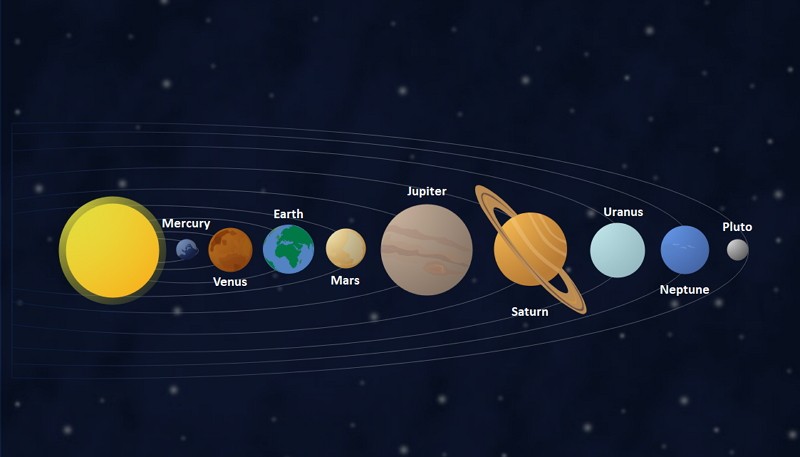
Planets divide into two groups: inner terrestrial (rocky) and outer gas/ice giants.
- Mercury: Smallest planet, closest to the Sun; extreme temperatures (-173°C to 427°C).
- Venus: Hottest planet (average 464°C); thick CO₂ atmosphere.
- Earth: Only known planet with life; 71% water-covered.
- Mars: Red planet with largest volcano (Olympus Mons) and polar ice caps.
- Jupiter: Largest planet; gas giant with Great Red Spot storm.
- Saturn: Famous for stunning ice/rock rings.
- Uranus: Tilted on its side; faint rings.
- Neptune: Windy ice giant; deepest blue color.
Moons and Rings
- Jupiter: Over 95 moons, including Europa (subsurface ocean) and Ganymede (largest moon).
- Saturn: 146 moons; intricate ring system visible from Earth.
Other Members: Asteroids, Comets, and Dwarf Planets
- Asteroid Belt: Between Mars and Jupiter; millions of rocky bodies (e.g., Ceres, a dwarf planet).
- Kuiper Belt: Beyond Neptune; icy objects including Pluto.
- Oort Cloud: Distant spherical shell; source of long-period comets.
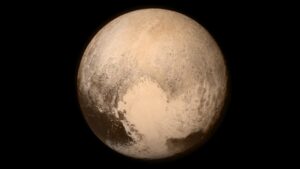
- Pluto: Famous dwarf planet with heart-shaped glacier; explored by New Horizons in 2015.
The Solar System is dynamic missions like Artemis and upcoming explorations continue revealing its secrets.