El Salvador, the smallest yet most densely populated country in Central America, has a history marked by indigenous heritage, colonial oppression, revolutionary fervor, and post-war reconstruction. Often overshadowed by its civil war, its story reveals a nation of perseverance and cultural depth, ideal for those seeking to understand Latin American dynamics.
Pre-Columbian Roots: Indigenous Civilizations and the Pipil Legacy
El Salvador’s human history begins with Paleo-Indian settlers around 10,000 BCE, but organized societies emerged later. The Lenca people, arriving circa 1200 BCE, established early villages in the east. By 600 CE, Mayan influences permeated the west, with sites like Joya de Cerén dubbed the “Pompeii of the Americas” preserving a snapshot of daily life buried by volcanic ash in 600 CE.
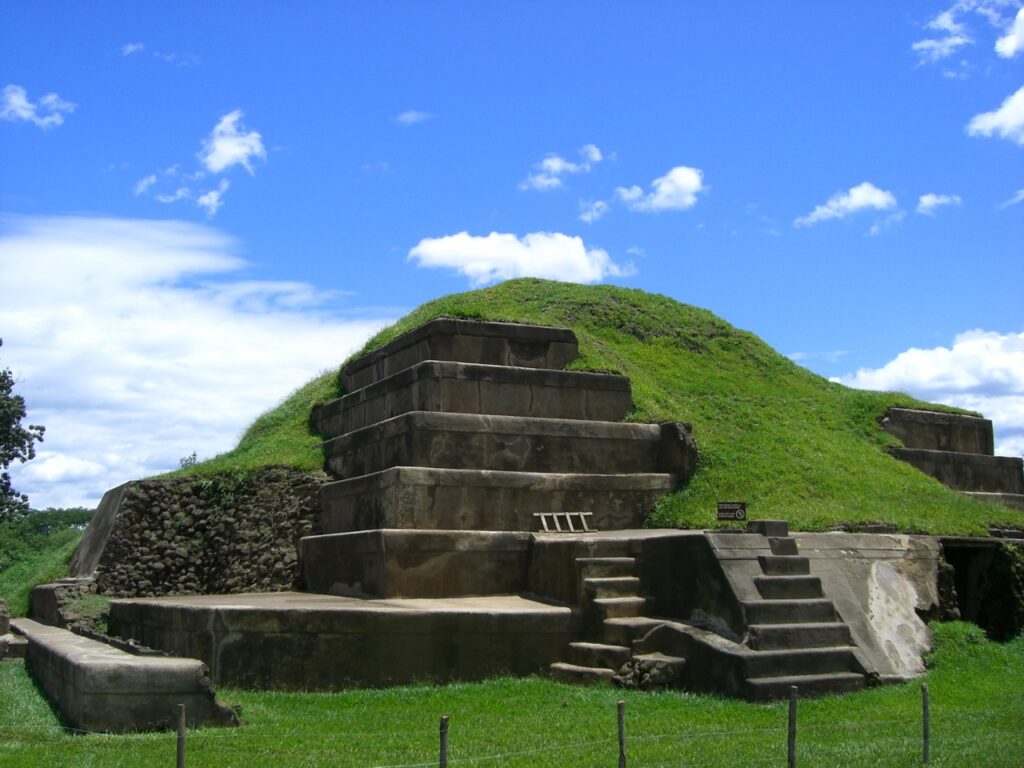
The dominant group by the 11th century was the Pipil, Nahua speakers from Mexico who founded Cuzcatlán (“Land of Precious Things”). They built pyramid temples, practiced advanced agriculture with maize and cacao, and organized into city-states. Trade networks connected them to Mesoamerica, and their society emphasized warfare and religion, with gods like Quetzalcoatl. Archaeological treasures at Tazumal and San Andrés highlight their architectural prowess, blending Mayan and Aztec elements.
Resistance to external threats shaped their culture, but internal divisions weakened them before European arrival.
Spanish Conquest and Colonial Era: Exploitation and Resistance
In 1524, Pedro de Alvarado invaded from Guatemala, clashing with Pipil forces at Acaxual. By 1525, the Spanish subdued much of the region, incorporating it into the Captaincy General of Guatemala. Indigenous populations plummeted due to disease and enslavement, dropping from 500,000 to under 100,000 by 1600.
The colonial economy relied on indigo dye and later coffee, cultivated on haciendas using forced labor. African slaves supplemented the workforce, leading to a mestizo majority. The Catholic Church played a pivotal role, converting locals and building Baroque churches in San Salvador and Suchitoto.
Uprisings like the 1811 revolt led by José Matías Delgado foreshadowed independence. Economic grievances and Enlightenment ideas fueled discontent, culminating in Central America’s independence from Spain in 1821.
Independence and the Federal Republic: Early Struggles and Division
El Salvador joined the Mexican Empire briefly before forming the United Provinces of Central America in 1823. Liberal reforms under Manuel José Arce clashed with conservative elites, leading to civil war. The federation dissolved in 1841, making El Salvador independent.
The 19th century was chaotic, with over 50 governments amid caudillo rivalries. Coffee booms from the 1860s enriched “Las Catorce” families, who controlled half the land by 1900. Indigenous lands were privatized via 1881 laws, sparking the 1898 La Matanza uprising, suppressed brutally.
Presidents like Gerardo Barrios (1859–1863) modernized education and infrastructure, but inequality persisted, setting the stage for 20th-century turmoil.
20th Century: Dictatorships, Uprisings, and Civil War
Military rule began in 1931 with Maximiliano Hernández Martínez’s coup, suppressing a 1932 peasant revolt led by Farabundo Martí, killing 30,000 in La Matanza. This event radicalized politics, birthing the FMLN guerrilla group later.
Post-1948, military juntas promised reforms but delivered repression. The 1969 “Football War” with Honduras displaced Salvadorans, exacerbating tensions. By the 1970s, leftist groups challenged the elite, leading to death squads and the 1980 assassination of Archbishop Óscar Romero, a human rights advocate.
The civil war (1980–1992) pitted the U.S.-backed government against FMLN rebels, causing 75,000 deaths and massive displacement. Atrocities like the El Mozote massacre (1981) drew international condemnation. The 1992 Chapultepec Accords ended the war, demilitarizing society and establishing the FMLN as a political party.
Post-War Era: Reconstruction, Gangs, and Contemporary Challenges
The 1990s focused on rebuilding, with ARENA party neoliberal policies boosting maquiladoras but widening inequality. Earthquakes in 2001 devastated infrastructure, while dollarization stabilized the economy.
Gang violence surged post-war, with MS-13 and Barrio 18 roots in U.S. deportations. Remittances from 2 million Salvadorans abroad sustain families. FMLN’s Mauricio Funes (2009–2014) and Salvador Sánchez Cerén (2014–2019) implemented social programs, reducing poverty.
Nayib Bukele’s 2019 election promised change, cracking down on gangs with mass arrests, slashing murder rates but raising human rights concerns. Bitcoin adoption in 2021 aimed at financial inclusion, amid environmental debates over mining.