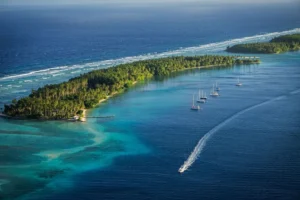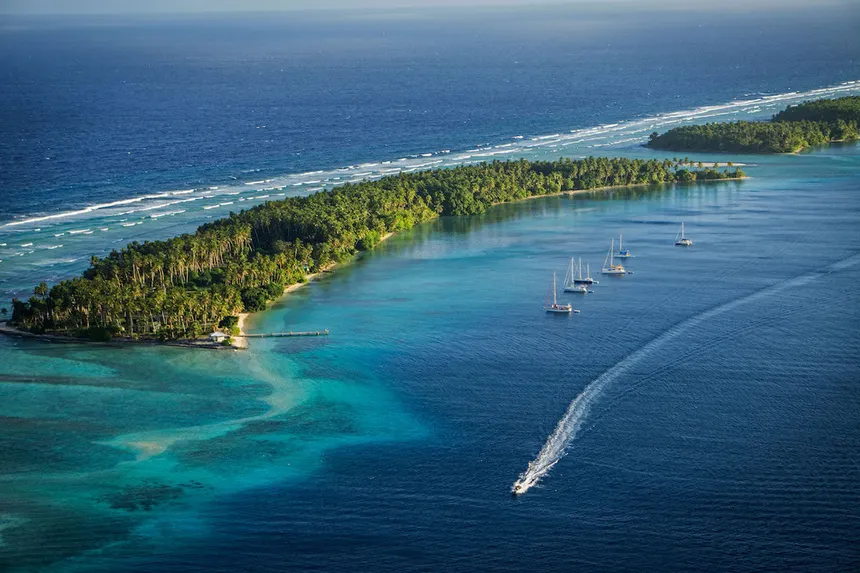
Nestled in the vast Pacific Ocean, the Republic of the Marshall Islands (RMI) comprises 29 coral atolls and five islands, home to a resilient Micronesian people. Spanning over 750,000 square miles of ocean, its history is a blend of ancient navigation, colonial exploitation, and post-war independence. This SEO-optimized exploration delves into the Marshall Islands’ past, from prehistoric settlers to modern challenges, revealing a nation shaped by the sea and global powers.
Pre-Colonial Era: Micronesian Mastery of the Oceans
Human settlement in the Marshall Islands began around 2000 BCE, when Austronesian-speaking voyagers from Southeast Asia navigated the Pacific using stars, waves, and stick charts ingenious maps made from shells and sticks depicting ocean swells. These early Marshallese developed a matrilineal society, with land passed through women, and clans organized around chiefs (Iroij).
Life revolved around fishing, coconut cultivation, and breadfruit farming. Outrigger canoes enabled inter-atoll trade, fostering a culture rich in oral traditions, tattoos, and navigation lore. Archaeological evidence from Bikini and Enewetak Atolls shows sophisticated societies with thatched houses and communal gathering places. By the 1500s, the islands were divided into eastern (Ratak) and western (Ralik) chains, each with distinct dialects but shared customs.
Also See : The History of the Maldives From Ancient Buddhist Kingdoms to a Global Luxury Destination
European contact began sporadically; Spanish explorer Álvaro de Saavedra sighted the islands in 1529, but no settlement followed.
Age of Exploration and Early Colonialism
The 18th and 19th centuries brought more explorers. British Captains John Marshall and Thomas Gilbert visited in 1788, naming the islands after Marshall. Russian Otto von Kotzebue mapped them in 1817, introducing the name “Marshall Islands.”
Whalers and traders arrived in the 1850s, bringing diseases like smallpox that decimated populations. Christian missionaries, primarily from the American Board of Commissioners for Foreign Missions, converted many by the 1870s, blending Protestantism with local beliefs.
In 1885, Germany annexed the Marshalls as part of German New Guinea, establishing copra (dried coconut) plantations. German rule (1885–1914) introduced schools, hospitals, and infrastructure but exploited labor, leading to uprisings like the 1911 revolt on Jaluit Atoll.
World Wars and Japanese Mandate
During World War I, Japan seized the islands from Germany in 1914, later receiving a League of Nations mandate in 1920. Under Japanese administration (1914–1944), the Marshalls became a strategic outpost. Japan built airfields, schools, and promoted immigration, with over 100,000 Japanese settling by the 1930s.
However, forced labor and cultural suppression sparked resistance. In World War II, the islands were a Pacific theater hotspot. The U.S. captured Kwajalein in 1944’s bloody Battle of Kwajalein, using it as a base for further assaults. Intense fighting on Enewetak and other atolls left lasting scars, with unexploded ordnance still a hazard today.
American Trusteeship and the Nuclear Age
Post-WWII, the U.S. administered the Marshalls under the United Nations Trust Territory of the Pacific Islands (1947–1986). This era is infamous for nuclear testing. From 1946–1958, the U.S. detonated 67 nuclear devices in the northern atolls, equivalent to 1.6 Hiroshima bombs daily for 12 years.
The 1954 Bravo test on Bikini Atoll, 1,000 times Hiroshima’s power, caused radioactive fallout affecting Rongelap and Utirik inhabitants, leading to health issues like thyroid cancer and birth defects. Bikinians were relocated multiple times, inspiring global anti-nuclear movements. The Runit Dome on Enewetak, a concrete sarcophagus holding radioactive waste, now leaks due to climate change.
Despite devastation, the U.S. invested in infrastructure, education, and health, though dependency grew.
Road to Independence and Contemporary Challenges
Self-determination movements intensified in the 1960s. In 1979, the Marshalls adopted a constitution, achieving self-government. Full independence came in 1986 via the Compact of Free Association (COFA) with the U.S., providing defense, funding, and migration rights in exchange for military access.
The 1990s focused on economic diversification, with fisheries, tourism, and ship registry becoming key. However, climate change poses existential threats: rising seas endanger low-lying atolls, prompting international advocacy.
Recent history includes renewing the COFA in 2023, addressing nuclear legacy compensation, and spaceport developments on Kwajalein. The Marshallese diaspora in the U.S., especially Arkansas and Hawaii, maintains cultural ties through festivals and remittances.
Cultural Resilience and Global Significance
Marshallese culture endures through storytelling, weaving, and stick charts preserved in museums. Annual events like Manit Day celebrate heritage. The nuclear history fuels activism, with the RMI leading climate talks at the UN.
Today, with a population of about 60,000, the Marshall Islands symbolize Pacific resilience amid colonialism and environmental peril. Its history teaches lessons on imperialism, environmental justice, and indigenous ingenuity.
In conclusion, from ancient navigators to nuclear survivors, the Marshall Islands’ saga is a testament to human adaptability. Exploring this history enriches understanding of Pacific geopolitics and inspires action on global issues. (Word count: 798)