Ever wondered how cold or hot it gets in outer space? Unlike Earth, space doesn’t have a single “temperature” because it’s a vacuum with no air to hold or transfer heat conventionally. Temperatures in space can swing from near absolute zero in the shade to scorching hot in direct sunlight. In this article, we’ll break down the science behind these extremes, why space feels both freezing and blazing, and real examples from spacecraft and planets.
Why Space Temperature Is So Extreme
In a vacuum, heat transfer happens mainly through radiation no conduction or convection like on Earth. Objects in space absorb radiation from the Sun or stars and emit their own as blackbody radiation.
- In deep space, far from stars, the background temperature is the Cosmic Microwave Background (CMB) radiation: about 2.7 Kelvin (-454.81°F or -270.45°C). This is incredibly cold, close to absolute zero (-273.15°C).
- But near the Sun or in sunlight, temperatures soar. An object in direct sunlight can heat up dramatically because there’s no atmosphere to filter the rays.
How Hot Can Space Get?
In direct sunlight, especially close to the Sun:
- Near Earth’s orbit (1 AU from the Sun), surfaces facing the Sun can reach 120°C (248°F).
- Closer to the Sun, like on Mercury’s day side: up to 427°C (800°F).
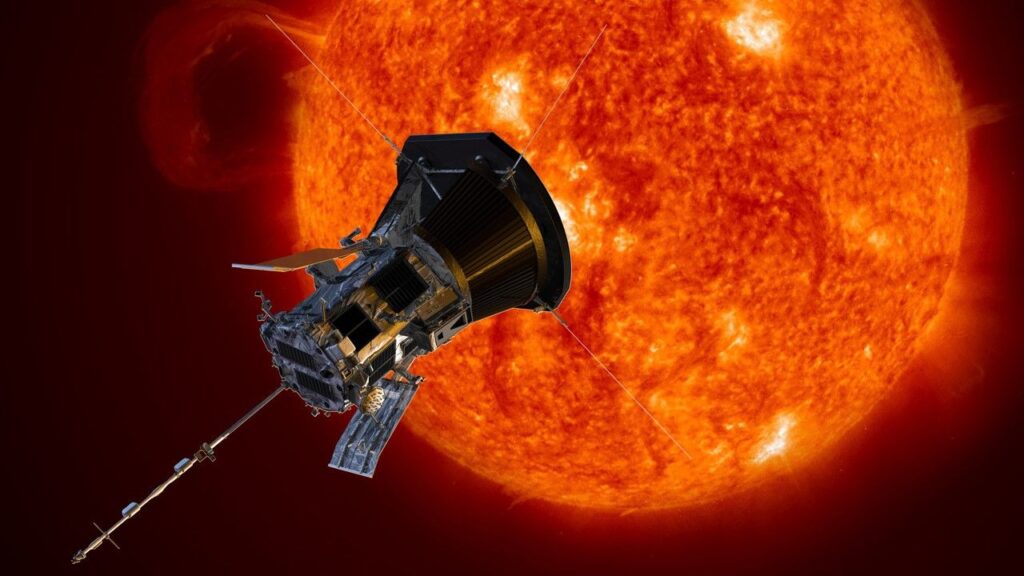
- NASA’s Parker Solar Probe, diving into the Sun’s corona, withstands temperatures over 1,377°C (2,500°F) thanks to its heat shield.
Spacecraft like the International Space Station (ISS) experience swings from -150°C in shadow to +120°C in sunlight, requiring advanced thermal control systems.
How Cold Can Space Get?
In the shadow or deep space:
- Objects lose heat rapidly by radiating it away, cooling to very low temperatures if not insulated.
- On the Moon’s night side or craters in permanent shadow: as low as -173°C (-280°F).
- In interstellar space: approaching the CMB’s 2.7 K.
Astronauts in spacesuits feel these extremes one side baking in the Sun, the other freezing in shadow.
Myths vs. Reality: Is Space Always Cold?
Many think space is always freezing because “no air means cold.” But it’s more accurate to say space has no temperature objects do. Without sunlight, things cool down fast, but sunlight makes them hot quickly.
Sci-fi often shows instant freezing in space, but in reality, it takes time for heat to radiate away.
Conclusion: The Wild Temperature Swings of the Cosmos
Temperatures in space range from nearly absolute zero (-270°C) in the void to over 1,000°C near stars. These extremes challenge spacecraft design and highlight why space exploration requires clever engineering.