Scientists widely accept the Big Bang theory as the leading explanation for the universe’s origin. About 13.8 billion years ago, the universe began as an extremely hot, dense point (a singularity) and has been expanding ever since. This guide breaks down the key stages, evidence, and latest insights from 2025 observations.
The Big Bang: The Beginning
The universe didn’t explode into space it was space itself that began expanding. At time zero, all matter, energy, space, and time emerged from a singularity: infinitely hot and dense.
- Not an explosion: Expansion stretched space uniformly in all directions.
- Pre-Big Bang?: Current physics can’t describe “before” time started with the Big Bang.
Diagrams of cosmic inflation: the rapid early expansion that set up the hot Big Bang.
Key Stages of Universe Formation
- Planck Era (0 to 10⁻⁴³ seconds): Quantum gravity dominates; no unified theory yet.
- Cosmic Inflation (10⁻³⁶ to 10⁻³² seconds): The universe expanded exponentially, faster than light, smoothing it out and magnifying quantum fluctuations into large-scale structures.
- Hot Big Bang Begins: Inflation ends; energy converts to particles and radiation. The universe becomes a hot plasma of quarks, gluons, and fundamental particles.
- Nucleosynthesis (first few minutes): Cooling allows protons and neutrons to form light elements: ~75% hydrogen, ~25% helium matching observations today.
- Recombination (380,000 years later): Universe cools to ~3,000 K; electrons bind to nuclei, forming neutral atoms. Light travels freely, creating the Cosmic Microwave Background (CMB).
- Dark Ages: Universe is neutral hydrogen gas; no stars yet.
- First Stars and Reionization (100–500 million years): Gravity forms first stars (Population III), massive and metal-free. Their light reionizes the universe.
- Modern Era: Galaxies merge, stars form heavier elements, leading to planets, life, and the universe we see.
Strong Evidence Supporting the Big Bang
- Expansion of the Universe: Galaxies redshift away (Hubble’s Law).
- Cosmic Microwave Background: Uniform 2.7 K radiation with tiny fluctuations seeding structures.
- Abundance of Light Elements: Precise hydrogen/helium ratios from early nucleosynthesis.
- Large-Scale Structure: Matches inflation predictions.
2025 Updates and Challenges
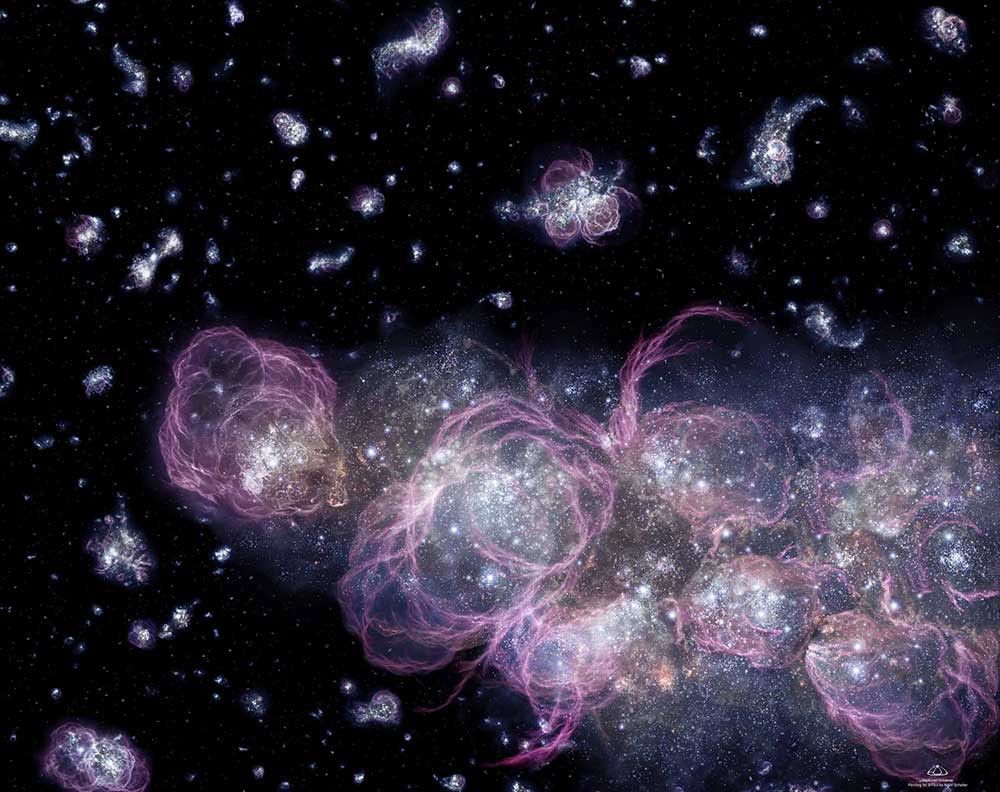
JWST observations reveal surprisingly mature, massive galaxies in the very early universe earlier than standard models predicted. This “tension” suggests faster early structure formation or refinements to the timeline, but the core Big Bang framework holds strong.
The Hubble tension (discrepant expansion rates) and dark matter/energy mysteries persist, driving new research.
The Big Bang theory remains our best-supported model, continually refined by telescopes like JWST.