The universe’s immense scale leaves scientists and stargazers in awe. But how large is the known universe specifically, the part we can observe? As of 2025, the observable universe spans about 93 billion light-years in diameter. This guide explores why it’s so enormous, how we measure it, and what lies beyond our cosmic horizon.
What Is the Observable Universe?
The observable universe includes everything whose light (or other signals) has reached Earth since the Big Bang. It forms a sphere centered on us, with a radius of about 46.5 billion light-years making the full diameter roughly 93 billion light-years.
Key facts:
- Age of the universe: Approximately 13.8 billion years.
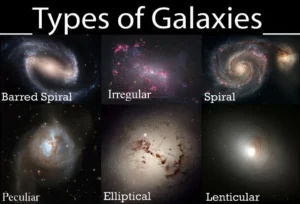
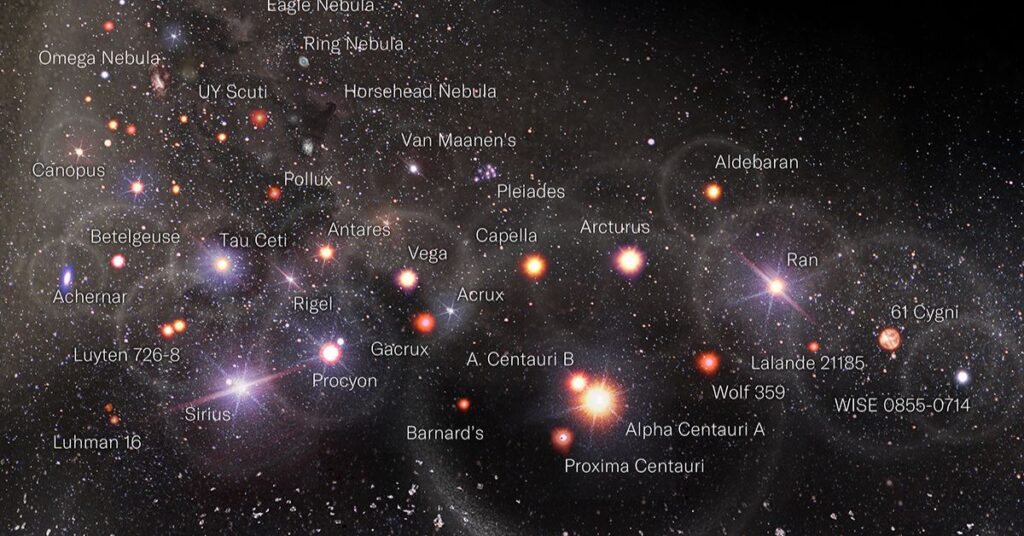
- Contains: An estimated 2 trillion galaxies and up to 10^24 stars.
- Volume: About 4 × 10^80 cubic meters.
Why Is It 93 Billion Light-Years Wide, Not Just 27.6 Billion?
Many assume the universe’s size equals twice its age in light-years (13.8 billion × 2 = 27.6 billion), but cosmic expansion changes that.
Here’s the explanation:
- The universe expands continuously → space stretches, carrying galaxies farther apart.
- Light from the farthest objects started traveling when the universe was smaller → by arrival, those objects sit much farther due to expansion.
- Current proper distance to the cosmic microwave background (CMB) edge: ~46.5 billion light-years.
- Result: Diameter ≈ 93 billion light-years (or precisely 28.5 gigaparsecs).
The Large-Scale Structure: The Cosmic Web
On vast scales, matter organizes into the cosmic web filaments, walls, and voids of galaxies and clusters.
- Filaments: Thread-like structures hundreds of millions of light-years long.
- Voids: Massive empty regions up to billions of light-years across.
- This structure formed from tiny quantum fluctuations in the early universe, amplified by gravity.
Beyond the Observable Universe Infinite or Finite?
The observable part is just what we can see the full universe may be much larger or infinite.
- No edge or center: The universe appears uniform in all directions (cosmological principle).
- Estimates: Some models suggest it’s at least 250–500 times larger than the observable portion; inflationary theory proposes it could be exponentially vast (10^23 times larger or more).
- Possibly infinite: If flat and endless, it extends forever with endless galaxies.
We can’t observe beyond the horizon because light hasn’t reached us yet and accelerating expansion (dark energy) means some regions will remain forever inaccessible.
Latest Insights in 2025
Cosmological parameters from Planck, Hubble, and JWST confirm the ~93 billion light-year figure. Ongoing debates about the Hubble tension (expansion rate discrepancies) might refine this slightly, but the scale remains consistent.
The observable universe’s vastness humbles us Earth is a tiny speck in a cosmic ocean containing more stars than grains of sand on all beaches.
Sources: NASA, Wikipedia, Britannica, Big Think, ESA/Hubble (updated December 2025).
Mind blown by the universe’s size? What’s your favorite cosmic scale fact? Comment below! For more, read our guides on the vacuum of space or black holes.