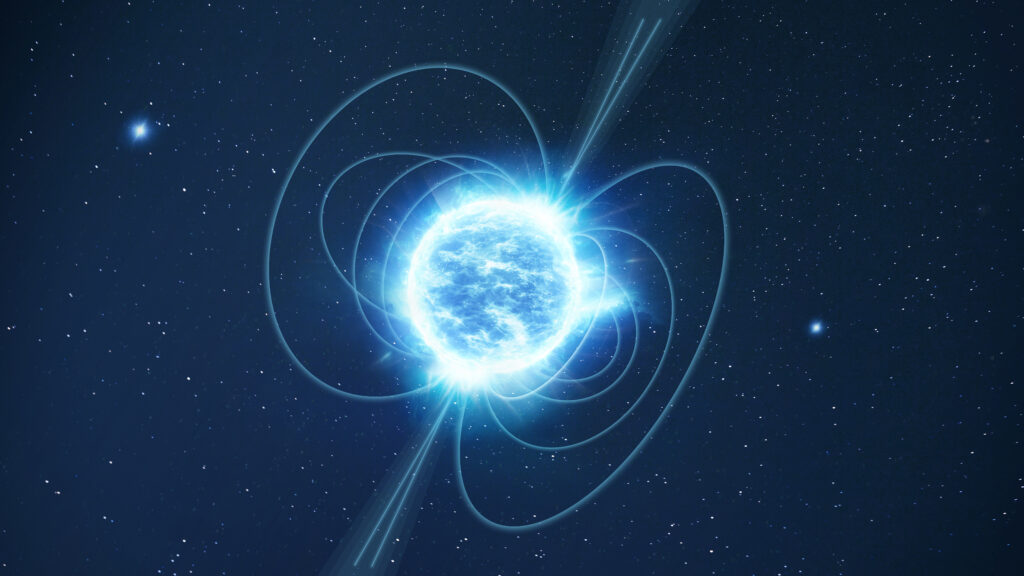
Neutron stars and pulsars represent some of the most extreme objects in the universe, born from the explosive deaths of massive stars. These dense remnants, packing the mass of our Sun into a sphere just 10-20 kilometers across, challenge our understanding of physics with their intense gravity, rapid spins, and powerful magnetic fields. Pulsars, a subset of neutron stars, act like cosmic lighthouses, emitting beams of radiation that sweep across space as they rotate. Discovered in 1967, these objects have revolutionized astronomy, offering insights into stellar evolution, gravitational waves, and even the potential for extraterrestrial navigation.
In this detailed guide, we’ll explore the formation, characteristics, and latest discoveries surrounding neutron stars and pulsars. Optimized for searches like “what are pulsars and neutron stars,” this article draws on recent research to provide an engaging, informative overview. From the Crab Pulsar’s enigmatic patterns to millisecond pulsars in binary systems, discover how these stellar corpses continue to pulse with scientific intrigue.
The Birth of Neutron Stars – From Supernova to Super-Dense Core
Neutron stars form when massive stars, typically 8-30 times the Sun’s mass, exhaust their nuclear fuel and undergo core collapse. The outer layers explode in a supernova, while the core compresses into a ball of neutrons, supported by quantum degeneracy pressure. This process creates densities so extreme that a teaspoon of neutron star material would weigh billions of tons on Earth.
Also See : Black Holes and How They Form – Decoding the Universe’s Darkest Secrets
Recent studies highlight the role of magnetic fields in this formation. For instance, observations of supernova remnants show how these fields influence the star’s initial spin and structure. Not all neutron stars become pulsars; only those with misaligned magnetic and rotation axes emit detectable beams.
Pulsars “Nature’s Precise Cosmic Clocks”
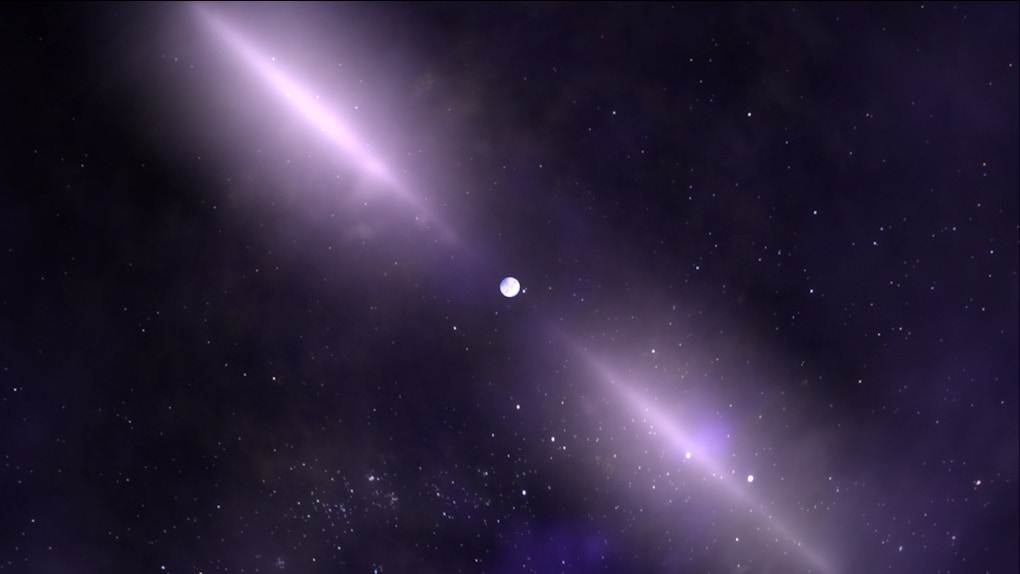
Pulsars are rapidly rotating neutron stars that emit beams of electromagnetic radiation from their magnetic poles. As they spin, these beams sweep across Earth like a lighthouse, creating regular pulses detectable in radio, X-ray, and gamma-ray wavelengths. Rotation periods range from milliseconds to seconds, with millisecond pulsars being the fastest, spun up by accreting material from companion stars.
The first pulsar, PSR B1919+21, was discovered by Jocelyn Bell Burnell, pulsing every 1.337 seconds. Today, over 3,000 pulsars are known, many in binary systems that test general relativity through orbital decays caused by gravitational waves. A recent discovery includes PSR J1928+1815, a millisecond pulsar orbiting a helium star, challenging formation theories.
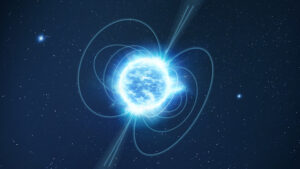
This depiction shows a pulsar emitting its characteristic beams.
Why Pulsars Shine Bright: A Half-Century-Old Mystery Solved
Magnetars and Other Exotic Variants
Not all neutron stars are standard pulsars. Magnetars possess magnetic fields up to a quadrillion times Earth’s, causing starquakes and gamma-ray bursts. These fields decay over time, influencing the pulsar’s evolution. Recent models confirm long-term magnetic decay explains observed pulsar populations.
Other variants include radio-quiet neutron stars and those in double pulsar systems, like the one discovered with the Parkes telescope, where two pulsars orbit each other, providing unique tests of gravity. Illustrations like this highlight the diversity of neutron star types.

Different Types of Neutron Stars (Illustration) | NASA Jet Propulsion Laboratory (JPL)
The Crab Pulsar: A Window into Neutron Star Mysteries
The Crab Pulsar, at the heart of the Crab Nebula, is one of the most studied. Born from a 1054 AD supernova, it spins 30 times per second, emitting across the spectrum. Recent research solved its “zebra pattern” in emissions, attributing it to plasma diffraction and gravitational lensing. This pattern offers insights into nebulae and supernovae.
Observations of the Crab reveal how pulsars interact with their environments, powering synchrotron radiation in remnants. Here’s an image of the Crab Nebula with its central pulsar.

Latest Discoveries and Future Prospects
Recent surveys, like those with China’s FAST telescope, uncovered four new pulsars, including precise millisecond ones for gravitational wave detection. Global collaborations have found over 700 in the galactic plane, including young and binary pulsars.
Future missions aim to probe neutron star interiors via gravitational effects and magnetic decay. Pulsars also aid in navigation and testing physics extremes.
In summary, neutron stars and pulsars are cosmic laboratories, revealing the universe’s violent side. Their study continues to yield breakthroughs, from magnetic evolution to gravitational insights. (Word count: 812)