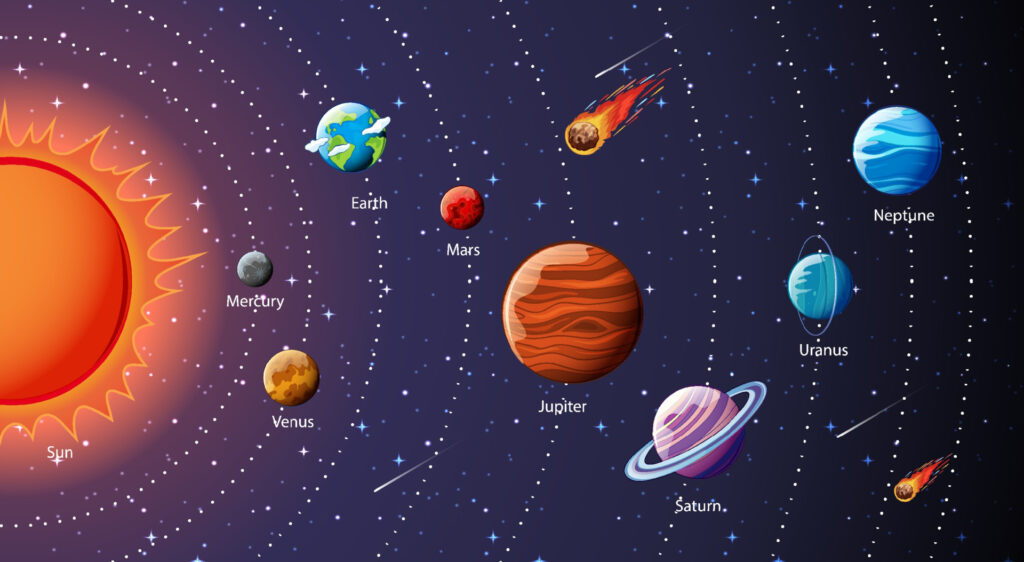
In our solar system, there are eight recognized planets orbiting the Sun. The closest planet to the Sun is Mercury, while the farthest is Neptune. These distances are typically measured using the average orbital distance (semi-major axis) in Astronomical Units (AU), where 1 AU is the average distance from Earth to the Sun (about 149.6 million kilometers or 93 million miles).
Closest Planet: Mercury
- Average distance from the Sun: 0.39 AU (approximately 58 million kilometers or 36 million miles).
- Mercury’s highly elliptical orbit means its distance varies from about 46 million km at perihelion (closest point) to 70 million km at aphelion (farthest point).
- As the nearest planet, Mercury experiences extreme temperatures, reaching up to 430°C (800°F) on the day side due to its proximity to the Sun.
Farthest Planet: Neptune
- Average distance from the Sun: 30.06 AU (approximately 4.5 billion kilometers or 2.8 billion miles).
- Neptune is the outermost major planet, taking about 165 Earth years to complete one orbit.
- Despite the vast distance, it has incredibly strong winds (up to 2,100 km/h) driven by internal heat.
Full Order of Planets by Average Distance from the Sun
Here’s the complete list with approximate average distances:
| Planet | Average Distance (AU) | Approx. Distance (million km) |
|---|---|---|
| Mercury | 0.39 | 58 |
| Venus | 0.72 | 108 |
| Earth | 1.00 | 150 |
| Mars | 1.52 | 228 |
| Jupiter | 5.20 | 778 |
| Saturn | 9.54 | 1,427 |
| Uranus | 19.2 | 2,871 |
| Neptune | 30.06 | 4,498 |