The history of Indonesia is a mesmerizing tale of ancient empires, spice trade routes, colonial struggles, and triumphant independence. As the world’s largest archipelago with over 17,000 islands, Indonesia boasts a rich tapestry of cultures, religions, and traditions. If you’re searching for an Indonesia history timeline, key events in Indonesian history, or fascinating stories from the archipelago, this guide dives into the milestones that shaped one of Southeast Asia’s most dynamic countries.
Ancient Glory Majapahit and Srivijaya Empires
Indonesia’s recorded history dates back over 2,000 years, with early Hindu-Buddhist kingdoms flourishing through maritime trade.
The Srivijaya Empire (7th–13th century) dominated Sumatra, controlling vital sea routes. Later, the Majapahit Empire (1293–1527) reached its peak under Gajah Mada, uniting much of the archipelago.
Iconic wonders like Borobudur (9th century, the world’s largest Buddhist temple) and Prambanan (9th century, a stunning Hindu complex) stand as testaments to this golden era.
These UNESCO sites continue to awe visitors with their intricate carvings and architectural brilliance.
The Spice Islands and European Arrival
Known as the “Spice Islands,” Indonesia’s nutmeg, cloves, and pepper drew traders from India, China, and Arabia. Islam spread peacefully from the 13th century, leading to powerful sultanates like Demak and Mataram.
In 1596, the Dutch arrived, followed by the establishment of the Dutch East India Company (VOC) in 1602 the world’s first multinational corporation.
VOC ships symbolized the intense competition for control over the lucrative spice trade.
By the 1800s, the Dutch fully colonized the islands, renaming them the Dutch East Indies.
The Rise of Nationalism and the Road to Independence
The 20th century sparked a national awakening. Organizations like Budi Utomo (1908) and Sarekat Islam fueled anti-colonial sentiment.
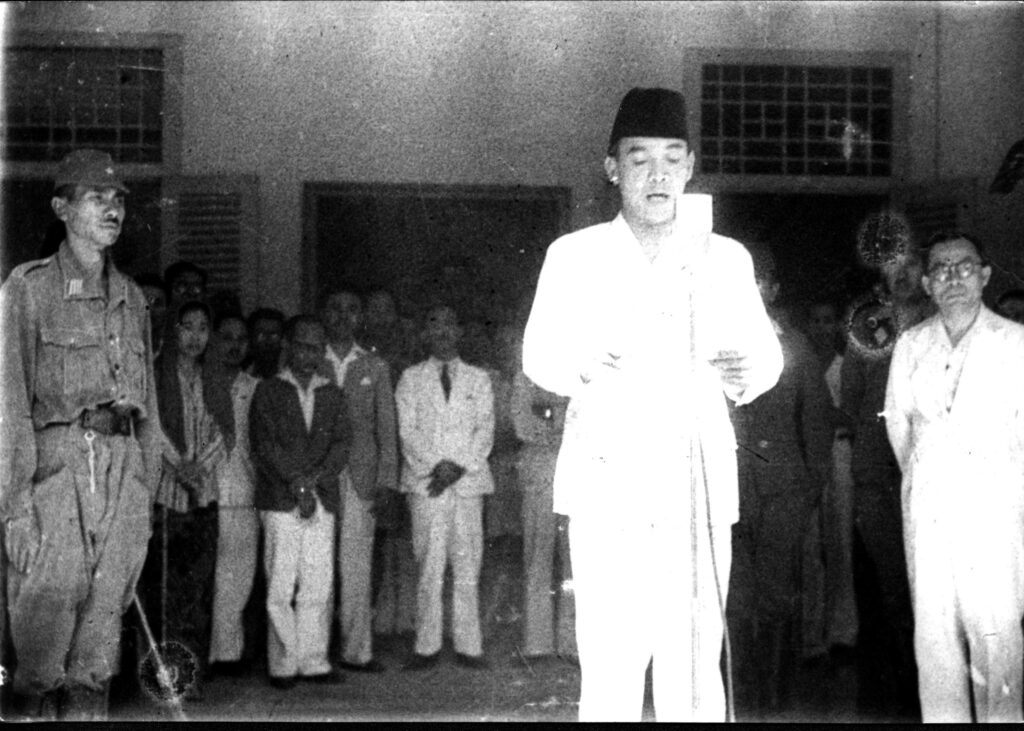
During World War II, Japan occupied Indonesia (1942–1945), weakening Dutch rule. On August 17, 1945, Sukarno and Mohammad Hatta proclaimed independence in Jakarta.
This historic moment, captured in iconic photos, ignited the Indonesian National Revolution (1945–1949) against returning Dutch forces.
The Garuda Pancasila, Indonesia’s national emblem, embodies the philosophy of Pancasila the five principles uniting a diverse nation.
Post-Independence: Challenges and Growth
Under President Sukarno (1945–1967), Indonesia adopted “Guided Democracy” and pursued non-aligned foreign policy. The 1965–1966 turmoil led to Suharto’s New Order era (1967–1998), marked by economic development but also authoritarian rule.
The 1998 Asian financial crisis sparked the Reformasi movement, ending Suharto’s regime and ushering in democracy.
Today, Indonesia is the world’s fourth-most populous country, a G20 member, and a hub of cultural diversity from Bali’s vibrant dances to Java’s ancient heritage.
Traditional Balinese performances highlight the enduring spirit of Indonesian arts.
Fun Facts from Indonesian History
- Indonesia has more than 300 ethnic groups and over 700 languages true unity in diversity (Bhinneka Tunggal Ika).
- Borobudur features 2,672 relief panels and 504 Buddha statues.
- The country declared independence just two days after Japan’s surrender in WWII.
The history of Indonesia inspires with its resilience, cultural richness, and journey from ancient kingdoms to a thriving democracy. From majestic temples to revolutionary heroes, it’s a story of enduring spirit. Which part of Indonesia’s past intrigues you most? Share below!