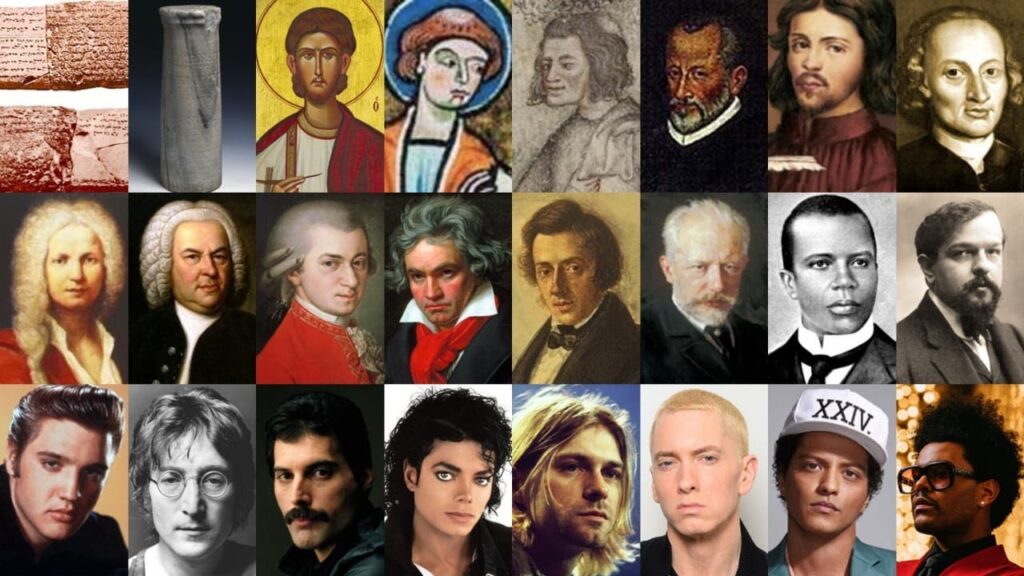
Music has been a fundamental part of human culture for thousands of years, evolving through distinct periods that reflect the social, technological, and artistic developments of their times. From ancient chants to modern electronic compositions, music continues to be a powerful form of human expression and connection.
Ancient Music (Pre-500)
The earliest known music dates back to ancient civilizations, with examples of musical notation surviving on papyrus or clay tablets. Ancient music included hymns, instrumental dance music, and storytelling songs, though much of it remains unknown due to the difficulty of transcribing ancient notation. This era laid the foundation for musical traditions that would influence future developments.
Medieval Period (500-1400)
The Medieval period saw the development of chant, instrumental music, and troubadours. Composers like Hildegard of Bingen and Guillaume de Machaut contributed to its evolution. This era used modes rather than modern diatonic scales and featured monophonic music before transitioning to polyphonic forms.
Renaissance (1400-1600)
The Renaissance brought more complex and emotional music, with techniques like “word painting” to illustrate meaning through musical gesture. Composers such as Josquin des Prez and Giovanni da Palestrina created chansons, motets, and madrigals, while the foundations of opera began to emerge.
Baroque (1580-1750)
The Baroque period introduced complex compositions with multiple lines of music, improvisation, and forms like the fugue and concerto. Composers like Johann Sebastian Bach and Antonio Vivaldi created works emphasizing expression and technical complexity.
Classical (1750-1820)
The Classical period focused on clarity and structure, with the rise of the piano and the development of sonata form. Composers such as Mozart, Beethoven, and Haydn created symphonies, concertos, and string quartets emphasizing melody and accompaniment.
Romantic (1800-1910)
The Romantic period emphasized emotion, with longer melodies, wider dynamics, and larger orchestras. Composers like Tchaikovsky, Brahms, and Wagner explored nationalism and the virtuoso performer.
Modernism (1890-1975)
Modernism brought a wide variety of styles, including atonal and serial music, and the influence of jazz and pop music. Composers such as Stravinsky, Schoenberg, and Bartók experimented with new harmonies and techniques.
Contemporary (1950-Present)
The Contemporary period continues to diversify, with styles ranging from atonal works to neoclassical compositions, and the rise of electronic music and minimalism. This era also sees increased diversity in composers from different backgrounds and the integration of technology in music creation.