Ireland, known as the Emerald Isle, has a history rich in mythology, resilience, cultural achievement, and struggle. From prehistoric monuments to its role in global migration and independence movements, Ireland’s story is one of enduring spirit and profound influence.
Prehistoric and Celtic Ireland: Cradle of Ancient Wonders
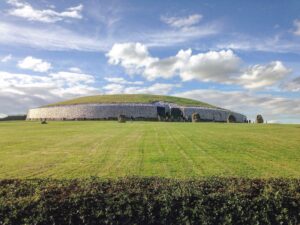
Human settlement in Ireland dates back to around 8000 BC, but the island’s most famous prehistoric site is Newgrange, a massive passage tomb built around 3200 BC older than the pyramids of Egypt and Stonehenge. Aligned with the winter solstice sunrise, it showcases remarkable Neolithic engineering and spiritual significance.
The iconic Newgrange tomb, a UNESCO World Heritage Site:
By the Iron Age (c. 500 BC), Celtic tribes dominated, bringing the Gaelic language, art, and druidic traditions. Ireland remained outside Roman control, preserving a distinct Celtic culture.
Christianization and the Golden Age of Monasteries
In the 5th century AD, St. Patrick is credited with bringing Christianity to Ireland. The faith blended with Celtic traditions, leading to a flourishing of monastic scholarship. Irish monks preserved classical knowledge during Europe’s Dark Ages, producing illuminated manuscripts like the Book of Kells.
From the 8th–11th centuries, Viking raids brought destruction but also trade and urban growth (Dublin was founded as a Viking settlement). The Norman invasion in 1169 marked the beginning of English involvement.
English Conquest and Centuries of Conflict
Under Henry II (1171), England claimed lordship over Ireland. Over centuries, English rule intensified through plantations, especially under Elizabeth I and Cromwell. The Penal Laws (late 17th–18th centuries) severely restricted Catholic rights, leading to widespread poverty and emigration.
Dublin Castle, long the seat of British administration in Ireland:

The Great Famine (1845–1852) caused by potato blight and British policies killed about one million and forced another million to emigrate, devastating the population and fueling Irish nationalism.
The Road to Independence
The late 19th and early 20th centuries saw the rise of movements for Home Rule and full independence. The Easter Rising of 1916, though militarily defeated, galvanized support. The Anglo-Irish War (1919–1921) led to the Anglo-Irish Treaty (1921), creating the Irish Free State (26 southern counties) while six northern counties remained part of the UK as Northern Ireland.
Key figure in the struggle: Michael Collins, revolutionary leader and signatory of the treaty:

Exploring Michael Collins: The Iconic Figure from Cork – Visit Cork
Civil war followed (1922–1923) over the treaty. In 1937, the Free State adopted a new constitution, and in 1949, it became the fully independent Republic of Ireland, leaving the Commonwealth.
Ireland Today A Modern, Vibrant Nation
The late 20th century brought the Troubles in Northern Ireland (1960s–1998), ending with the Good Friday Agreement. The Republic enjoyed the Celtic Tiger economic boom (1990s–2000s), becoming a tech and finance hub. Despite the 2008 financial crisis, Ireland has recovered strongly.
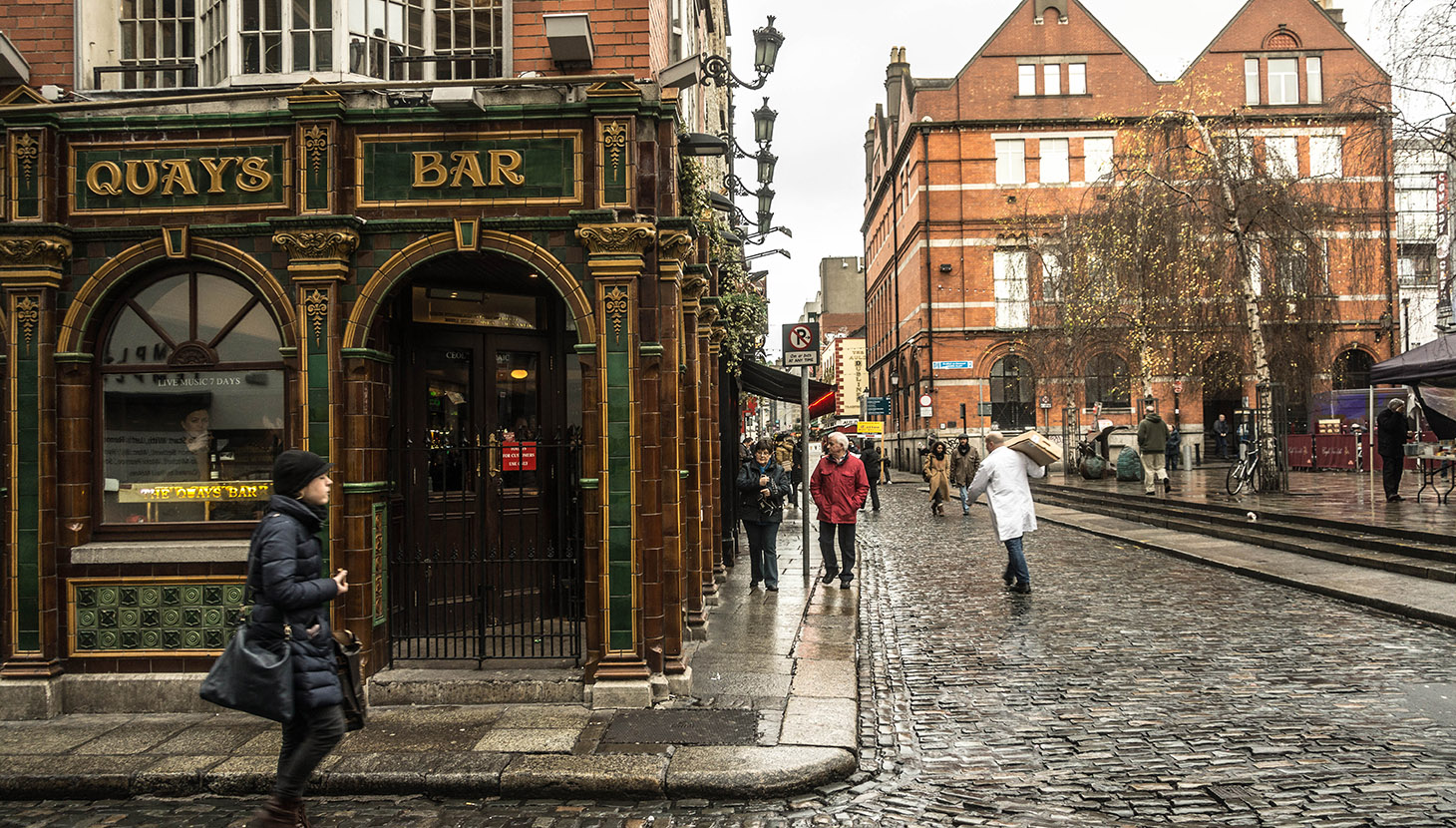
Dublin, the lively capital, blends historic charm with contemporary energy epitomized by the colorful streets of Temple Bar:

Ireland’s dramatic natural beauty endures, from the world-famous Cliffs of Moher:
:max_bytes(150000):strip_icc()/cliffs-of-moher-landscape-county-clare-ireland-MOHER0321-40a02114170148b884bab2e7ac90f895.jpg)
:max_bytes(150000):strip_icc()/TAL-cliffs-of-moher-from-sea-MOHER1024-c13a9c12d43f4d9094e57fa1c0704e03.jpg)
Trinity College Dublin, home to the Book of Kells and a symbol of intellectual heritage:

Legacy of the Emerald Isle
Ireland’s history reflects a journey from ancient mysticism and monastic learning to colonial oppression, famine, revolution, and modern prosperity. Its literature (Joyce, Yeats, Beckett), music, and global diaspora continue to shape the world.
Keywords: history of Ireland, ancient Ireland, Newgrange, Celtic Ireland, St. Patrick, Great Famine, Easter Rising 1916, Irish independence, Michael Collins, Republic of Ireland, Cliffs of Moher, Dublin history, Temple Bar
Ireland’s story is one of remarkable endurance, creativity, and cultural richness — a small island with an outsized global impact.