Malaysia, a Southeast Asian gem straddling the Malay Peninsula and parts of Borneo, is renowned for its stunning biodiversity, iconic landmarks like the Petronas Towers, and a harmonious blend of Malay, Chinese, Indian, and indigenous cultures. Bordered by Thailand, Indonesia, Singapore, and Brunei, this equatorial nation has evolved from ancient trading hubs to a modern economic powerhouse. If you’re delving into Malaysia’s origins, its colonial struggles, path to independence, or recent political shifts, this SEO-optimized guide covers the essential chapters—from prehistoric roots to contemporary challenges.
Malaysia’s story is one of migration, empire-building, resistance, and unity, shaped by its strategic position along historic trade routes like the Strait of Malacca.
Prehistoric and Early Settlements (Millions of Years Ago – 15th Century)
Human history in what is now Malaysia dates back tens of thousands of years:
- Archaeological evidence shows early human presence around 40,000–50,000 years ago, with Stone Age hunter-gatherers in areas like the Niah Caves in Sarawak.
- By 2,000 BCE, Austronesian peoples from Taiwan migrated southward, bringing agriculture, pottery, and seafaring skills, forming the basis of Proto-Malay societies.
- From the 1st century CE, Indian and Chinese traders influenced the region, introducing Hinduism, Buddhism, and early kingdoms like Langkasuka (in modern Kedah) and Gangga Negara.
By the 7th century, the Srivijaya Empire (centered in Sumatra but controlling Malacca) dominated maritime trade, spreading Malay culture and Buddhism. Islam arrived in the 14th century via Arab and Indian merchants, leading to the conversion of Malays and the rise of sultanates.
The Golden Age of Malay Sultanates (15th–18th Centuries)
The 15th century marked the zenith of Malay power:
- In 1400, Parameswara founded the Malacca Sultanate, which became a bustling entrepôt for spices, silk, and porcelain, attracting traders from China, India, and the Middle East.
- Under Sultan Mansur Shah (1459–1477), Malacca expanded, blending Islamic law with local customs and fostering a multicultural society.
European powers soon disrupted this era:
- 1511: Portuguese forces under Afonso de Albuquerque captured Malacca, establishing the first European foothold.
- 1641: The Dutch, allied with Johor, ousted the Portuguese and controlled Malacca until 1795.
- Meanwhile, Borneo saw the rise of the Brunei Sultanate and indigenous Dayak tribes.
Colonial Domination and British Influence (19th–Mid-20th Century)
The 19th century brought intensified European colonialism:
- 1786: Captain Francis Light established Penang as a British trading post, followed by Singapore in 1819 under Stamford Raffles.
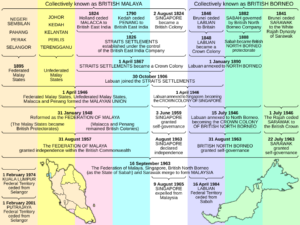
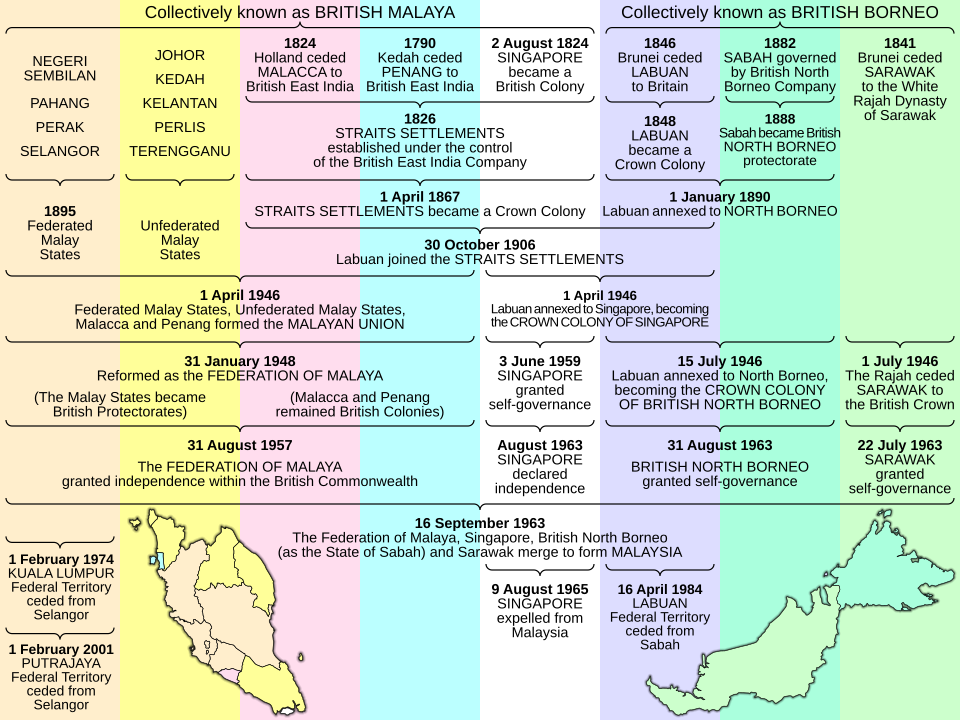
- 1826: The British formed the Straits Settlements (Penang, Malacca, Singapore), extending protectorates over Malay states via treaties like the Anglo-Dutch Treaty of 1824.
- 1909: Britain gained control of northern states (Kedah, Kelantan, Perlis, Terengganu) from Thailand via the Treaty of Bangkok.
- Economic booms in tin mining and rubber plantations attracted Chinese and Indian immigrants, reshaping demographics.
World War II shifted dynamics:
- 1941–1945: Japanese occupation during WWII; harsh rule spurred anti-colonial sentiments.
- Post-war, the British proposed the Malayan Union in 1946, but Malay opposition led to the Federation of Malaya in 1948.
Independence and Formation of Modern Malaysia (1950s–1960s)
Nationalism surged in the post-war era:
- 1946: United Malays National Organisation (UMNO) founded by Onn Jaafar to protect Malay rights.
- 1955: The Alliance (UMNO, MCA, MIC) won elections, paving the way for independence.
- August 31, 1957: Federation of Malaya gains independence from Britain, with Tunku Abdul Rahman as first prime minister.
- September 16, 1963: Malaysia formed by merging Malaya, Singapore, Sabah, and Sarawak (after the Cobbold Commission).
- 1965: Singapore separates due to racial and political tensions.
- 1969: Racial riots in Kuala Lumpur led to emergency rule and the New Economic Policy (NEP) to address inequalities.
Modern Malaysia: Economic Boom and Political Evolution (1970s–Present)
Malaysia transformed under visionary leaders:
- 1981–2003: Mahathir Mohamad’s premiership drove industrialization, privatization, and projects like the Multimedia Super Corridor and Petronas Towers.
- 1997–1998: Asian Financial Crisis hit hard, but Malaysia recovered through capital controls.
- 2003–2009: Abdullah Badawi focused on anti-corruption and Islam Hadhari.
- 2009–2018: Najib Razak’s era saw economic growth but was marred by the 1MDB scandal.
- 2018: Historic election; Pakatan Harapan coalition ousts Barisan Nasional after 61 years, with Mahathir returning as PM.
- 2020–Present: Political instability with multiple PM changes (Muhyiddin Yassin, Ismail Sabri, Anwar Ibrahim since 2022); focus on post-COVID recovery, green energy, and digital economy. As of 2026, Anwar’s unity government navigates economic reforms amid global challenges.
Today, Malaysia is a constitutional monarchy with a parliamentary system, led by a Yang di-Pertuan Agong (rotating king) and a prime minister. It boasts a high-income economy, driven by oil, electronics, and tourism.
Key Timeline of Malaysia History
- ~40,000 BCE: Early human settlements.
- 1400: Founding of Malacca Sultanate.
- 1511: Portuguese capture Malacca.
- 1826: Formation of Straits Settlements.
- August 31, 1957: Independence of Federation of Malaya.
- September 16, 1963: Formation of Malaysia.
- 1965: Singapore’s separation.
- 1969: May 13 racial riots.
- 1981–2003: Mahathir Mohamad’s leadership.
- 2018: Pakatan Harapan’s electoral victory.
- 2022: Anwar Ibrahim becomes PM.
Malaysia’s history embodies diversity and adaptability: a nation that turned colonial legacies into multicultural strength. Whether exploring ancient temples in Malacca or modern skyscrapers in Kuala Lumpur, its past offers profound insights into Southeast Asia’s dynamic evolution.