Micronesia is a region in the western Pacific Ocean made up of thousands of small islands. Among them is the Federated States of Micronesia (FSM), a nation known for its beautiful lagoons, diverse cultures, and long history of exploration and resilience. Despite its small size, Micronesia has a fascinating past shaped by ancient navigation, colonial rule, and independence.
Early Settlement and Island Cultures
The history of Micronesia begins thousands of years ago when the first settlers arrived by canoe across vast stretches of the Pacific Ocean. Archaeological research suggests that people began settling the islands around 2000 BCE.
These early inhabitants were skilled seafarers who navigated the ocean using stars, ocean currents, and natural signs such as bird movements and cloud formations. Their advanced navigation skills allowed them to travel between distant islands long before modern technology.
Over time, different island communities developed their own languages, traditions, and social structures. Despite these differences, they shared common cultural elements such as clan systems, traditional leadership, and strong connections to the ocean.
Also See : From Ancient Voyagers to Nuclear Legacy – The Intriguing History of the Marshall Islands
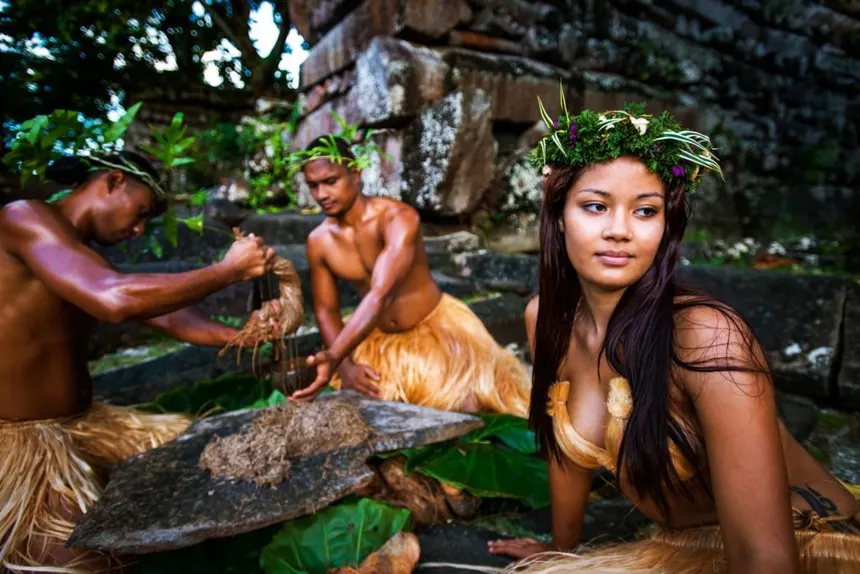
One of the most remarkable historical sites in Micronesia is Nan Madol, an ancient city built on artificial islands off the coast of Pohnpei. Constructed between the 12th and 17th centuries, Nan Madol served as the political and religious center of the Saudeleur dynasty. Massive stone structures and canals earned it the nickname “the Venice of the Pacific.”
European Exploration
The first Europeans arrived in Micronesia during the Age of Exploration in the 16th century. Spanish explorers sailing across the Pacific Ocean encountered several island groups and claimed them for Spain.
For many years, however, Spain maintained limited direct control over the islands. Due to their remote location and scattered geography, Micronesian communities continued to live largely according to their traditional ways.
Missionaries eventually arrived and began spreading Christianity across the islands. European trade also introduced new goods, technologies, and diseases that affected local populations.
Colonial Rule by Multiple Powers
In the late 19th century, Spain sold many of its Pacific island territories to Germany after losing influence in the region. In 1899, the Caroline Islands, which include much of modern Micronesia, became part of the German colonial empire.
German rule focused on developing plantations and expanding trade. However, this period did not last long. After Germany’s defeat in World War I, the League of Nations transferred control of the islands to Japan.
Under Japanese administration from 1914 to 1945, Micronesia experienced significant changes. Japan developed infrastructure, introduced new industries such as fishing and sugar production, and encouraged Japanese settlement in the islands.
World War II and American Administration
Micronesia became an important strategic location during World War II. Several islands served as military bases for Japan, making them targets for Allied forces.
One of the most famous battles in the region occurred at Truk Lagoon (now Chuuk Lagoon), where American forces launched a major attack in 1944 that destroyed many Japanese ships and aircraft.
After Japan’s defeat, the United States took control of Micronesia as part of the Trust Territory of the Pacific Islands, administered under the authority of the United Nations. During this period, the United States helped develop education, healthcare, and infrastructure in the islands.
However, many Micronesians began advocating for greater self-government and independence.
The Road to Independence
In the 1970s, leaders from several island districts worked together to establish a new political system. In 1979, the Federated States of Micronesia adopted its own constitution and formed a national government.
The country consists of four states: Yap, Chuuk, Pohnpei, and Kosrae. Each state maintains its own traditions and leadership structures while participating in the national government.
In 1986, Micronesia officially became an independent nation under a Compact of Free Association with the United States. This agreement allows Micronesia to govern itself while receiving economic assistance and defense support from the United States.
Micronesia Today
Today, the Federated States of Micronesia is a peaceful island nation known for its natural beauty, marine biodiversity, and strong cultural traditions. Fishing, agriculture, and tourism are important parts of the economy.
Traditional practices such as canoe building, navigation, and community ceremonies remain an important part of everyday life. Many communities continue to honor their ancestral knowledge and connection to the sea.
Despite challenges such as climate change and economic development, Micronesia continues to preserve its heritage while building a sustainable future.
The history of Micronesia is a story of exploration, cultural resilience, and adaptation. From ancient navigators who crossed the Pacific to modern independence, the people of Micronesia have maintained a unique identity shaped by the ocean and their island home.