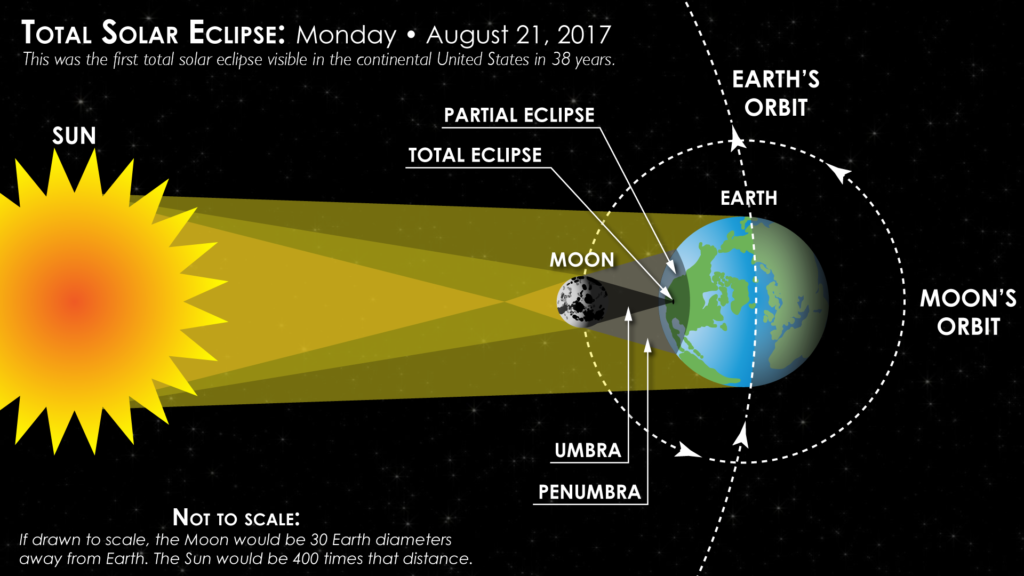
Lunar eclipses occur when Earth passes directly between the Sun and the Moon, casting Earth’s shadow across the lunar surface. They are safe to observe with the naked eye and often appear dramatic in the night sky.
What Is a Lunar Eclipse
A lunar eclipse happens when the Moon enters Earth’s shadow during a full moon. Depending on how deeply the Moon travels into that shadow, the eclipse may be total or partial.
Why Lunar Eclipses Do Not Happen Every Month
Because the Moon’s orbit is tilted, most full moons pass above or below Earth’s shadow. Only when the alignment is exact does a lunar eclipse occur.
Total Lunar Eclipse
In a total lunar eclipse, the Moon enters Earth’s darkest shadow. It often appears reddish or copper colored, creating what is popularly called a Blood Moon.
This color comes from sunlight filtered through Earth’s atmosphere, similar to the red tones seen during sunrise or sunset.
The Stages of a Lunar Eclipse
- Penumbral phase begins
- Partial eclipse starts
- Totality begins for total eclipses
- Maximum eclipse
- Totality ends
- Partial eclipse ends
- Penumbral phase ends
Partial Lunar Eclipse
During a partial lunar eclipse, only part of the Moon moves into Earth’s darkest shadow. The rest remains illuminated, giving the Moon a sharply curved dark edge.
How to Observe a Lunar Eclipse
Anyone located where the Moon is above the horizon during the event can watch a lunar eclipse. Binoculars or small telescopes provide better detail but are not required.
Cultural and Scientific Importance
Lunar eclipses have inspired stories, myths, and early scientific thinking throughout history. Today, astronomers use them to analyze Earth’s atmosphere and lunar surface features.
Whether total or partial, lunar eclipses remind us of Earth’s place in space and provide a striking example of planetary alignment.