In our hyper-connected 2026 world, fiber optic cables are the backbone of high-speed internet, telecommunications, and data transfer. These thin strands of glass or plastic transmit information at the speed of light, far surpassing traditional copper wires. This article delves into the science behind fiber optics, their structure, functionality, and future implications. Whether you’re curious about your home internet or global networks, understanding how fiber optic cables work will illuminate this cutting-edge technology.
The Basics of Fiber Optic Technology
Fiber optics rely on light to carry data. Unlike electrical signals in copper cables, light pulses travel through optical fibers with minimal loss. Invented in the 1970s, they’ve evolved to support terabit speeds. Today, they’re essential for 5G, cloud computing, and streaming services.
A fiber optic cable consists of a core, cladding, and protective layers. The core, made of silica glass, guides light. Cladding reflects light back into the core, preventing escape.
How Light Travels Through Fiber Optic Cables
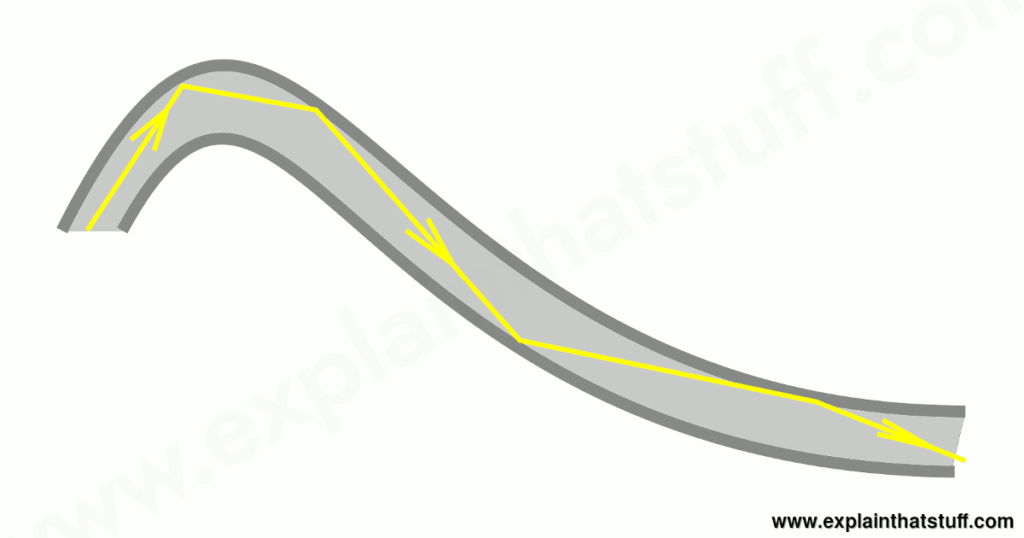
The principle is total internal reflection. Light enters the core at an angle, bouncing off the cladding repeatedly. This allows data to travel long distances without degradation.
Data is encoded as light pulses from lasers or LEDs. Binary code (1s and 0s) corresponds to on/off light. At the receiver, photodetectors convert light back to electrical signals.
Types include single-mode (for long distances) and multi-mode (for shorter runs). Single-mode uses a narrow core for precise light paths, ideal for undersea cables.
The Structure of a Fiber Optic Cable
- Core: Diameter of 9-62.5 micrometers.
- Cladding: Surrounds the core, with a lower refractive index.
- Buffer Coating: Protects from moisture and damage.
- Strength Members: Aramid yarns for tensile strength.
- Outer Jacket: Shields against environmental factors.
Cables can bundle hundreds of fibers for massive bandwidth.
Advantages Over Traditional Cables
Fiber optics offer higher bandwidth, longer distances (up to 100 km without repeaters), immunity to electromagnetic interference, and security (hard to tap). They’re lighter and more efficient, reducing energy costs.
Installation and Maintenance
Laying fiber involves trenching or aerial methods. Splicing connects fibers using fusion or mechanical techniques. Maintenance uses OTDR (Optical Time-Domain Reflectometer) to detect faults.
Challenges include fragility bends can cause signal loss and high initial costs, though prices drop yearly.
Applications in Modern Life
From internet backbones to medical endoscopes, fiber optics are ubiquitous. In 2026, they’re pivotal for AI data centers, smart cities, and telemedicine.
Future of Fiber Optics
Advancements like hollow-core fibers promise even faster speeds. Quantum communication via fiber could revolutionize secure data transfer.
Fiber optic cables have transformed how we connect, enabling the digital age. As technology advances, their role will only grow.