The Shining Giants of the Universe
Stars are among the most fascinating objects in the universe. They light up the night sky, guide ancient navigation, and play a crucial role in the formation of galaxies and planets. But what exactly is a star, and how does it form? This article explores the scientific definition of stars and the incredible process behind their birth.
What Is a Star?
A star is a massive, glowing sphere of hot gas, primarily hydrogen and helium, held together by gravity. Unlike planets, stars produce their own light and heat through nuclear fusion occurring in their cores. Our Sun is a perfect example of a typical star.
Stars vary in size, temperature, brightness, and color. Some are much larger than the Sun, while others are smaller and cooler. Despite these differences, all stars share the same fundamental structure and formation process.
The Role of Gravity in Star Formation
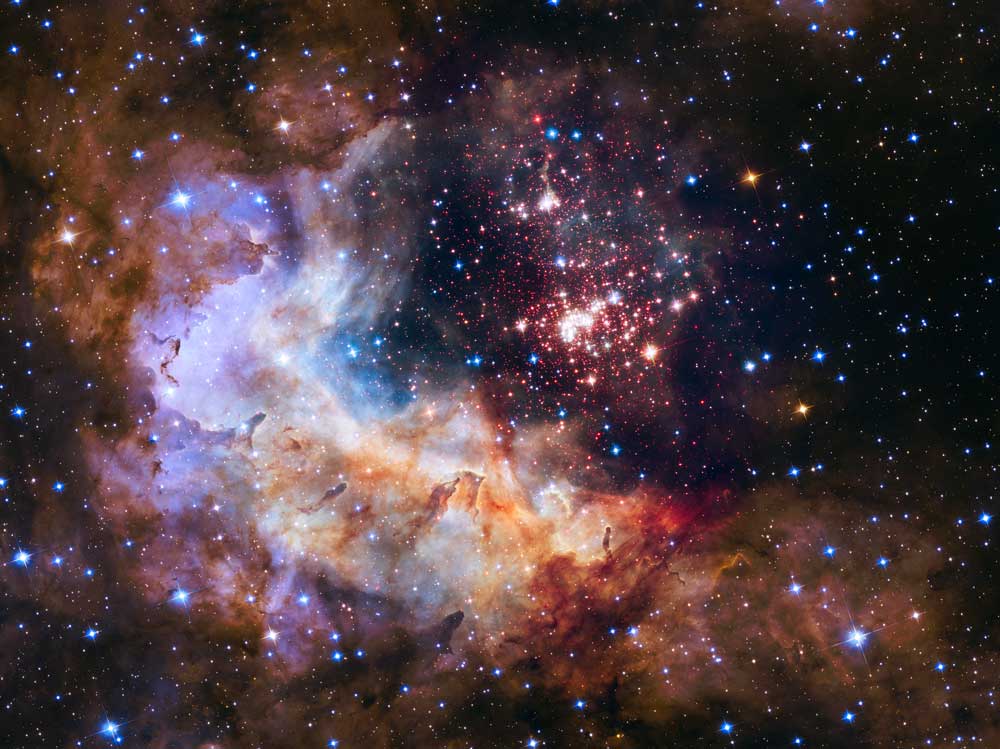
Star formation begins with gravity. In space, vast clouds of gas and dust known as nebulae drift through galaxies. When a region of a nebula becomes dense enough, gravity causes it to collapse inward. As the material contracts, it begins to heat up.
This collapsing region is called a protostar, the earliest stage of a star’s life. At this stage, the object is not yet producing energy through fusion, but it continues to grow hotter and denser.
From Protostar to Main Star
As the protostar contracts, the temperature in its core rises dramatically. When it reaches about 10 million degrees Celsius, nuclear fusion ignites. Hydrogen atoms begin fusing into helium, releasing enormous amounts of energy. This marks the birth of a true star.
Once fusion starts, an outward pressure balances gravity, creating stability. The star then enters the main sequence phase, where it will spend most of its life.
Why Nebulae Are Called Stellar Nurseries
Nebulae are often referred to as stellar nurseries because they are regions where new stars are constantly being born. Famous examples include the Orion Nebula and the Eagle Nebula, both visible with powerful telescopes.
Why Star Formation Matters
Star formation is essential for the evolution of the universe. Stars create heavier elements through fusion, such as carbon and oxygen, which later become the building blocks of planets and life.
Stars are not just distant points of light. They are powerful engines of creation, born from clouds of gas through gravity and nuclear fusion. Understanding how stars form helps us better understand the origins of galaxies, solar systems, and even life itself.