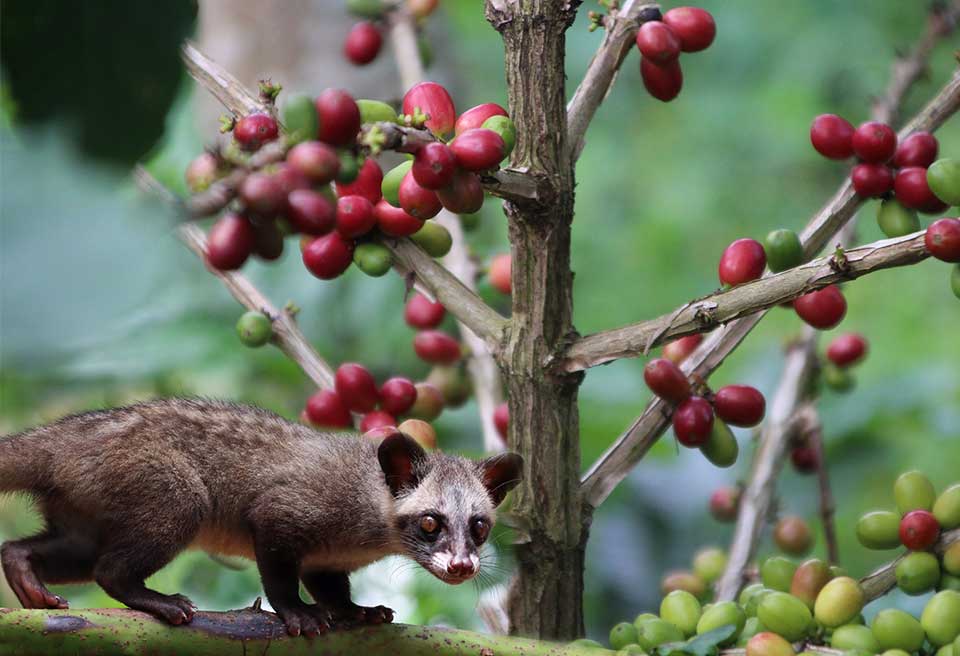
Kopi Luwak, also known as civet coffee, is one of the world’s most expensive and controversial coffees. Originating primarily from Indonesia (with some production in the Philippines, Vietnam, and other Southeast Asian countries), it’s made from coffee beans that have been eaten, partially digested, and excreted by the Asian palm civet (a small, nocturnal mammal that looks like a cat-raccoon hybrid).
The unique flavor often described as smoother, less bitter, and with earthy or chocolate notes comes from enzymes in the civet’s digestive system that break down proteins in the beans during fermentation.
Step-by-Step Production Process
- Selection and Consumption:
Wild civets naturally roam coffee plantations at night and selectively eat only the ripest, reddest coffee cherries (the fruit containing the beans). In caged production (more common due to demand), civets are fed cherries directly. - Digestion and Excretion:
The civet digests the fruity pulp but not the hard inner beans. Enzymes and stomach acids ferment the beans over 24-36 hours, altering their chemical composition. The beans are then excreted in clumps of feces. - Collection:
Farmers or collectors gather the droppings (from the wild forest floor or directly from cages). - Cleaning and Processing:
The beans are thoroughly washed to remove any residue, then sun-dried or air-dried. The outer parchment skin is removed (hulled), and beans are sorted by quality. - Roasting and Packaging:
Finally, the beans are roasted (usually medium to preserve the unique profile) and packaged for sale.
The entire process is labor-intensive, contributing to its high price (often $100–$1,300 per kilogram).
Wild vs. Caged Production (and Ethical Concerns)
Traditionally, Kopi Luwak was wild-sourced: Civets freely chose the best cherries, and collectors harvested droppings without harming animals. This method is rare today.
Due to skyrocketing global demand, most production now involves caged civets on farms. Animals are often kept in tiny, barren battery cages, force-fed coffee cherries (an unnatural diet), leading to stress, malnutrition, infections, and high mortality. Many products labeled “wild-sourced” are reportedly mislabeled from caged animals.
Animal welfare groups like PETA and World Animal Protection strongly condemn this, calling for boycotts. Some producers now focus on truly ethical, wild-sourced beans with certifications, but fraud remains common.