Have you ever wondered why planets orbit the Sun instead of flying off into space or crashing into it? The answer lies in a perfect balance of gravity and motion, rooted in physics discovered centuries ago. In this article, we’ll explore the key reasons behind planetary orbits, from the formation of our solar system to the laws governing them.
The Role of Gravity: Newton’s Universal Law
The primary force keeping planets in orbit is gravity. According to Newton’s Law of Universal Gravitation, every object with mass attracts every other object. The Sun, with its massive size (accounting for 99.8% of the solar system’s mass), exerts a powerful gravitational pull on the planets.
This force acts like an invisible string, constantly pulling planets toward the Sun. Without it, planets would travel in straight lines away from the solar system.
Inertia and Orbital Balance
Planets don’t fall into the Sun because of inertia the tendency of moving objects to continue in a straight line (Newton’s First Law of Motion). When the solar system formed, planets gained sideways (tangential) velocity.
Gravity curves this straight-line path into a closed orbit: the planet perpetually “falls” toward the Sun but misses due to its forward speed, creating a stable elliptical path.
How Orbits Formed: The Nebular Hypothesis
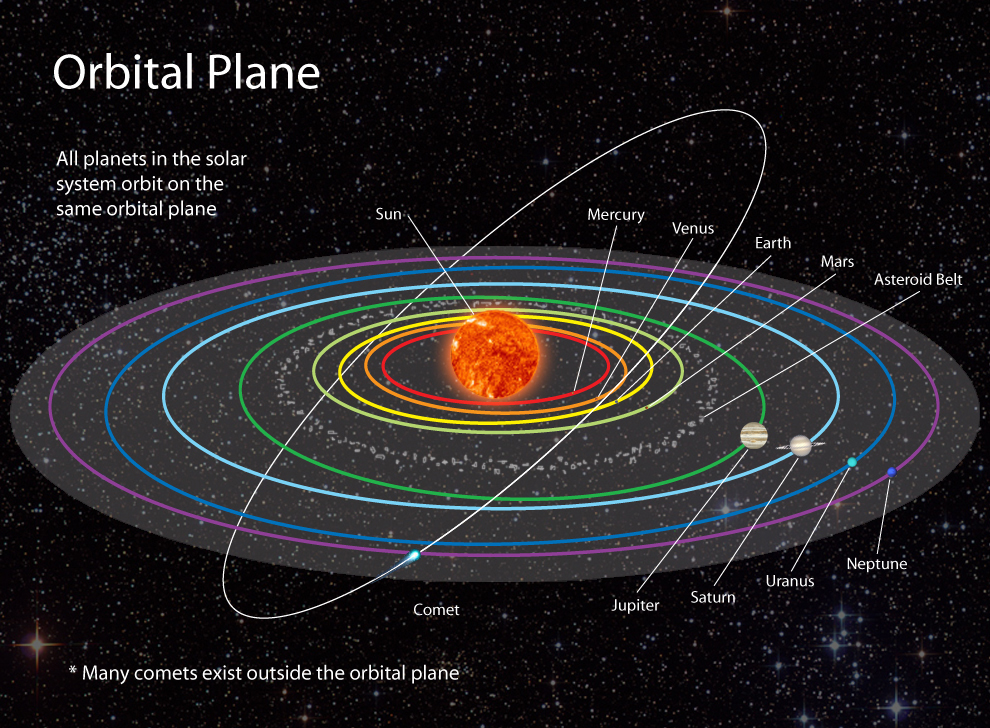
About 4.6 billion years ago, a collapsing cloud of gas and dust (nebula) formed the Sun at its center. The remaining material flattened into a protoplanetary disk due to rotation and conservation of angular momentum.
Particles in this spinning disk clumped together to form planets, inheriting the disk’s orbital motion all moving in the same direction around the Sun.
Kepler’s Laws: Describing the Orbits
Johannes Kepler’s three laws refine our understanding:
- First Law: Planets orbit in ellipses with the Sun at one focus (not perfect circles).
- Second Law: Planets sweep equal areas in equal times, moving faster when closer to the Sun.
- Third Law: Orbital period squared is proportional to semi-major axis cubed.
These laws, later explained by Newton’s gravity, show orbits are predictable and stable.
Why Stable Orbits Persist
Orbits remain stable because the gravitational force exactly balances the centrifugal tendency from motion. Small perturbations (like from other planets) exist, but overall, the system is dynamically stable over billions of years.
Conclusion: A Delicate Cosmic Dance
Planets orbit the Sun due to the interplay of gravitational attraction and inherited inertial motion, originating from the solar system’s formation. This elegant balance keeps our cosmic neighborhood in harmony.