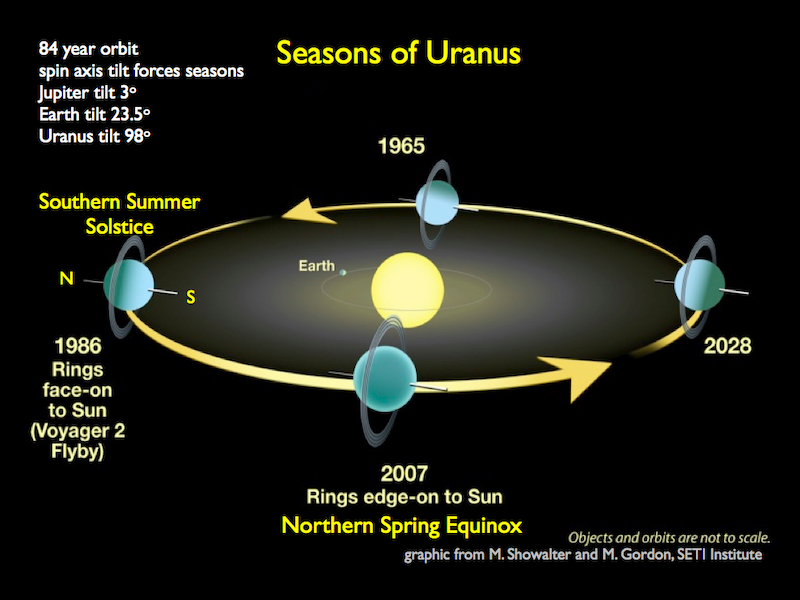
Uranus, the seventh planet from the Sun, is unique among solar system planets for its extreme axial tilt of 97.77 degrees. This makes it appear to “roll” around the Sun on its side, unlike Earth’s gentle 23.5-degree tilt. The tilt causes bizarre seasons, with each pole experiencing 42 years of continuous sunlight followed by 42 years of darkness.
Uranus – The Sideways Ice Giant
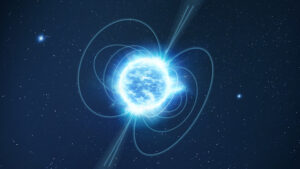
Discovered in 1781 by William Herschel, Uranus is an ice giant composed mostly of water, ammonia, and methane ices. Its pale blue color comes from methane absorbing red light. The extreme tilt affects its magnetosphere, which is offset and tilted 60 degrees from the rotation axis unlike any other planet.
This orientation leads to the most extreme seasons in the solar system, plunging half the planet into decades-long winter while the other basks in summer.
Leading Theory – Giant Impacts
The most widely accepted explanation is one or more massive collisions early in the solar system’s history. An Earth-sized object (or multiple smaller ones) likely smashed into Uranus, knocking it sideways. Simulations show such impacts could eject debris that formed its moons and rings.
This violent event, occurring billions of years ago when giant impacts were common, explains why Uranus is the only planet with such a severe tilt. Neptune, its sibling, remained upright.
Alternative Theory – A Lost Moon’s Influence
Recent research (2022–2025) proposes a less violent cause: a large ancient moon that migrated outward. Gravitational interactions in a spin-orbit resonance gradually tipped Uranus over 80 degrees. The moon then crashed into the planet, locking the tilt.
This requires a satellite just 0.1% of Uranus’ mass, migrating over millions of years a common occurrence in young planetary systems.
Other Explanations and Evidence
Some models suggest a massive circumplanetary disk during formation created resonances that tilted the planet. Voyager 2’s 1986 flyby provided key data: the tilted magnetic field and retrograde moons support the impact theory.
No single theory is proven, but impacts remain favored due to the turbulent early solar system.
Consequences of the Tilt
The sideways rotation creates wild weather: poles warmer than the equator during solstice. It also hides auroras and complicates exploration. Uranus’ 84-year orbit means we’ve only seen one full season cycle.
Future missions, proposed for the 2030s, could reveal more about its interior and confirm the cause.
Uranus’ odd spin makes it a cosmic oddball, highlighting how chaotic planetary formation can be. Understanding it helps explain exoplanets with similar tilts.