One of the most famous space facts: there is no sound in outer space. Movies often show dramatic explosions with booming noises, but in reality, space is completely silent. This guide explains the scientific reason, debunks myths, and explores why the vacuum of space blocks sound waves.
The Main Reason: Sound Needs a Medium
Sound is a mechanical wave that travels by vibrating particles in a medium like air, water, or solids. These vibrations compress and rarefy the medium, carrying energy to our ears.
In outer space:
- It’s a near-perfect vacuum with extremely low particle density (often just a few atoms per cubic meter).
- No particles mean nothing to vibrate → sound waves can’t propagate.
Hollywood Myths vs. Reality
Sci-fi films add explosive sounds for drama, but real space events are silent:
- A massive asteroid impact? No boom.
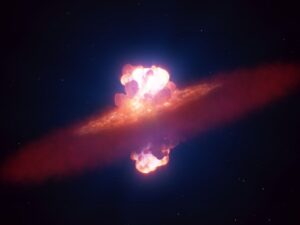
- Spaceship explosion? Completely quiet.
- Astronauts screaming outside? No one hears it.
If you were in space without a suit, you’d pass out quickly but not from noise; from lack of pressure and oxygen.
Exceptions: Where Sound Exists in Space
- On planets/moons with atmospheres: Like Mars (thin air allows faint sounds) or Titan.
- Inside spacecraft: Air-filled cabins let astronauts talk normally.
- Plasma “sounds”: In dense interstellar clouds, electromagnetic waves can convert to audible frequencies (NASA sonification projects).
- Gravitational waves: Not sound, but ripples in spacetime detected as “chirps” by LIGO.
True acoustic sound? Only with a medium.
Why This Matters for Space Exploration
Understanding silence in space drives designs for:
- Radio communication (electromagnetic waves travel in vacuum).
- Vibration-dampening systems on spacecraft.
- Astronaut suits with internal comms.
The silence of space highlights its extreme vacuum one of the harshest environments.
Mind-blown by space’s silence? What’s your favorite space myth? Comment below! For more, check our guides on the vacuum of space or why space is dark.